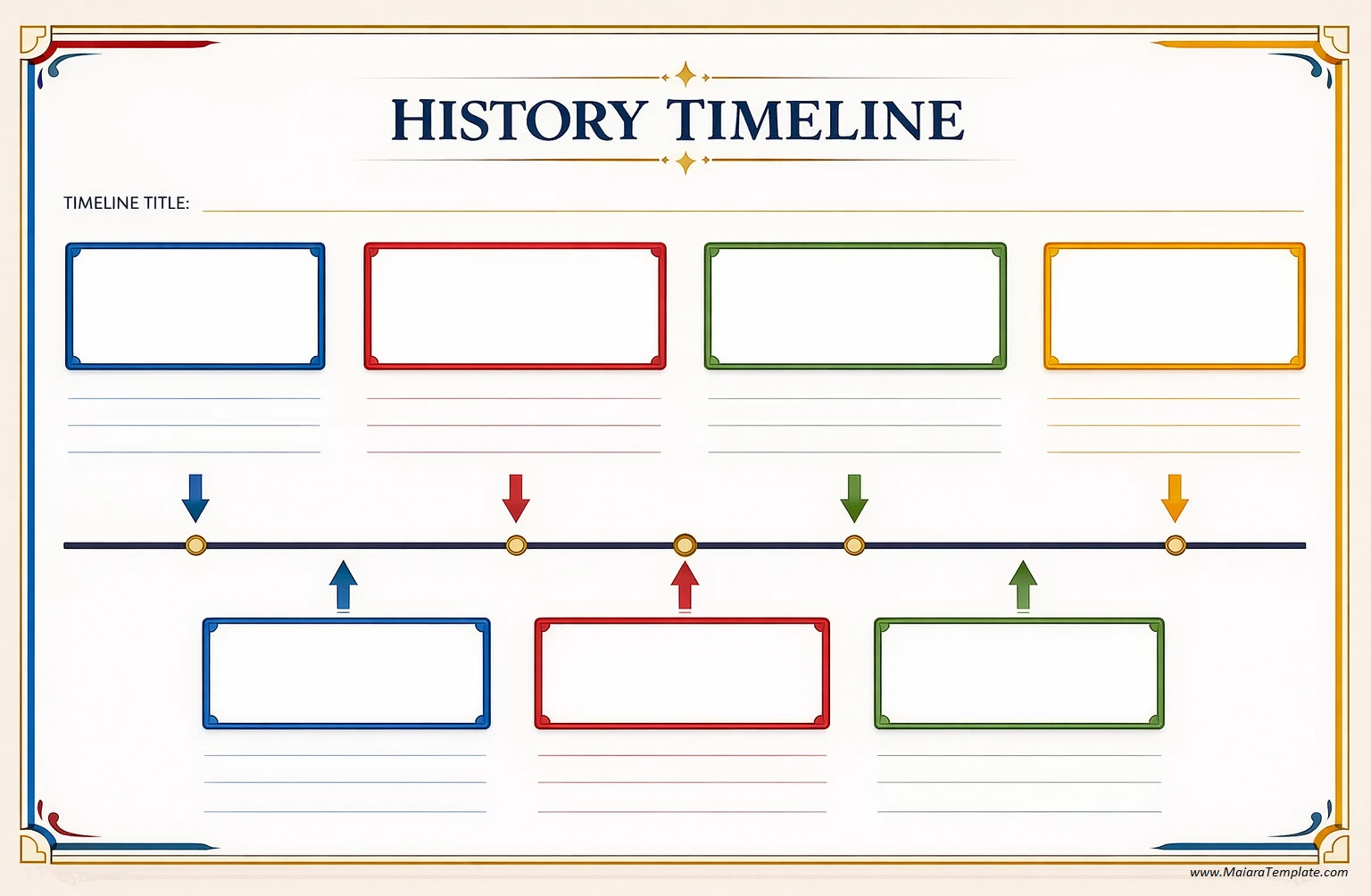
History timelines are powerful tools that visually organize events chronologically, making it easier to understand the sequence, duration, cause-and-effect, and patterns of historical happenings.
Whether used by students in a classroom setting or by historians conducting research, timelines play a crucial role in improving comprehension and revealing connections between different eras, cultures, and developments. By placing events in context, showing big-picture trends, identifying turning points, and serving as powerful learning tools, history timelines are indispensable in the study of the past.
What Are History Timelines?
History timelines are visual representations of chronological events, presenting a sequential overview of historical occurrences in a linear format. They provide a structured framework for organizing historical data, allowing viewers to grasp the flow of time and the relationships between different events.
By presenting information clearly and concisely, timelines make complex historical narratives more accessible and comprehensible.
Why Are History Timelines Important?
1. Enhanced Comprehension: Timelines help individuals better understand the sequence of events and the context in which they occurred, leading to improved comprehension of historical developments.
2. Revealing Connections: By visually connecting events across time periods, timelines highlight the relationships and influences between different historical moments, cultures, and movements.
3. Identifying Trends and Patterns: Timelines allow for the identification of overarching trends, patterns, and recurring themes in history, providing insights into the evolution of societies and civilizations.
4. Contextualizing Events: Placing events within a larger historical context helps viewers see the bigger picture and understand the significance of individual occurrences within the broader scope of history.
5. Learning Tool: Timelines serve as effective tools for both students and historians, facilitating the study of history by organizing information in a structured and easily digestible format.
Key Elements of History Timelines
When creating history timelines, several key elements should be considered to ensure their effectiveness and clarity:
1. Chronological Order: Events should be arranged in sequential order to accurately depict the passage of time.
2. Title and Labels: Each timeline should have a clear title and labels for events to provide context and aid in understanding.
3. Visual Design: Utilize color coding, symbols, and graphics to enhance the visual appeal and organization of the timeline.
4. Scale and Proportion: Maintain a consistent scale to accurately represent the duration and significance of events.
5. Connections and Relationships: Use lines or arrows to connect related events and show cause-and-effect relationships.
6. Annotations and Descriptions: Include brief descriptions or annotations for each event to provide additional context and information.
7. Key Milestones: Highlight key milestones, turning points, and significant events to emphasize their importance within the timeline.
8. Flexibility: Allow for flexibility in adding or adjusting events as new information becomes available or perspectives change.
How to Create a History Timeline
Creating a history timeline can be a straightforward process with the following steps:
1. Choose a Theme or Topic: Select a specific theme, time period, or historical event to focus your timeline on.
2. Gather Information: Research and compile relevant historical events, dates, and details to include in the timeline.
3. Select a Format: Decide on the format of your timeline, whether digital or physical, and choose a layout that best suits your content.
4. Arrange Events: Organize the events in chronological order, ensuring a logical flow from one event to the next.
5. Add Visual Elements: Enhance the visual appeal of the timeline by incorporating color coding, symbols, and graphics to differentiate events.
6. Include Descriptions: Provide brief descriptions or annotations for each event to offer context and additional information.
7. Review and Refine: Double-check the accuracy of dates and information, and refine the timeline for clarity and coherence.
8. Share and Discuss: Share your history timeline with others to promote discussion, analysis, and a deeper understanding of the historical context.
Tips for Using History Timelines Effectively
– Focus on Key Events: Highlight key events that are pivotal in shaping historical developments and understanding.
– Use Visual Cues: Utilize visual cues such as color coding, symbols, and images to aid in memory retention and comprehension.
– Update and Revise: Regularly update and revise your timeline to incorporate new information or perspectives.
– Engage in Discussion: Use your history timeline as a starting point for discussions, debates, and analysis of historical topics.
– Compare and Contrast: Compare multiple timelines to identify similarities, differences, and connections between different historical narratives.
– Utilize Online Tools: Explore online timeline creation tools and software to create interactive and dynamic history timelines.
– Collaborate with Others: Work with peers, colleagues, or students to create collaborative history timelines and share insights and perspectives.
– Seek Feedback: Solicit feedback from others on your timeline to improve its clarity, accuracy, and overall effectiveness.
Conclusion
In conclusion, history timelines are invaluable tools for organizing, understanding, and contextualizing historical events. By visually representing the flow of time, timelines enhance comprehension, reveal connections between different eras, cultures, and developments, and serve as powerful learning tools for students and historians alike.
Through the careful selection of key elements, a thoughtful creation process, and effective utilization of timelines, individuals can gain a deeper appreciation and insight into the complexities of the past. Embrace the power of history timelines to unlock the richness of historical narratives and create meaningful connections across time and space.
History Timeline Template – DOWNLOAD

- Printable Weekly Cleaning Schedule Template - September 17, 2026
- Free Printable Travel Budget Template - September 17, 2026
- Printable Weekly Lesson Planner Template - September 17, 2026
