A professional biography is a short introduction that explains who you are, what you do, and what makes your experience valuable. It helps colleagues, clients, employers, and potential business partners understand your professional background, expertise, and achievements. A well-written biography can also strengthen your personal brand and establish credibility in your industry.
Whether you are a business owner, freelancer, job seeker, executive, consultant, or creative professional, a professional biography can help you present your experience clearly. You can use it on a company website, LinkedIn profile, personal portfolio, speaker page, or professional application.
Writing about yourself can feel challenging, especially when you need to decide which details to include and how to make your experience sound engaging without exaggeration. The key is to focus on relevant qualifications, meaningful accomplishments, and the value you bring to your work.
In this guide, you will learn what a professional biography is, how to write one step by step, what information to include, and how to adapt your bio for different professional situations. You will also find examples and practical tips for creating a clear, polished biography.
What Is a Professional Biography?
A professional biography is a concise summary of a person’s career, expertise, qualifications, and professional achievements. It introduces the individual to an audience and explains why their background or experience is relevant.
Unlike a resume, which usually lists employment history, education, and skills in a structured format, a professional bio presents selected details in a readable narrative. It often uses third-person language for formal settings, although first-person writing can be suitable for personal websites and social profiles.
A professional biography can be a few sentences long or several paragraphs, depending on its purpose. A short bio may be appropriate for a social media profile, while a longer biography may be more suitable for a company leadership page or conference speaker introduction.
Why Is a Professional Biography Important?
A strong professional biography helps people understand your background and recognize the experience you bring to your work. It can support several professional goals.
1. Builds Professional Credibility
Relevant qualifications, experience, and accomplishments help readers understand your expertise. A factual and well-organized biography can create a positive first impression without relying on exaggerated claims.
2. Strengthens Your Personal Brand
Your biography communicates what you do, what you value, and how you approach your work. Consistent messaging across your website, portfolio, and professional profiles helps people recognize your professional identity.
3. Creates Networking Opportunities
A clear introduction makes it easier for potential clients, employers, collaborators, and industry contacts to understand your background. It can also help them identify shared interests or relevant professional experience.
4. Supports Career Development
A professional bio can complement a resume, job application, portfolio, or promotion request. By highlighting your expertise and achievements, it helps readers understand the value you may bring to a position or organization.
5. Makes Online Profiles More Effective
Many employers and clients review online profiles before making contact. A well-written biography provides useful context and gives visitors a reason to explore your work or learn more about your services.
What Should a Professional Biography Include?
The best professional biographies focus on information that is relevant to the intended audience. You do not need to include every detail of your career. Instead, select the information that explains your expertise and professional value.
Your Name and Current Role
Begin with your name and current position, professional title, or primary area of work. This immediately tells readers who you are and what you do.
Your Professional Background
Summarize your experience, industry knowledge, and career path. Mention the types of organizations, projects, or clients you have worked with when those details help establish your qualifications.
Key Skills and Areas of Expertise
Identify the skills most relevant to your current work. Depending on your profession, these might include project management, software development, strategic planning, communication, research, design, or business consulting.
Notable Achievements
Include accomplishments that demonstrate your contributions. Whenever possible, use specific and verifiable results rather than broad claims.
For example, you might describe a successful project, a process you improved, a professional award, a publication, or a measurable business outcome.
Education and Qualifications
Include relevant degrees, professional certifications, licenses, or specialized training. These details are especially useful when formal qualifications are important in your field.
Professional Interests and Values
A brief statement about your professional interests or working philosophy can make your biography more distinctive. Choose details that help readers understand your approach to work rather than adding unrelated personal information.
A Closing Statement
Finish with a sentence that reinforces your current focus, professional goals, or the value you aim to provide. For a business biography, you can also mention the services or expertise you offer.
How to Write a Professional Biography Step by Step
You do not need to be an experienced writer to create a compelling professional bio. Following a simple process can help you organize your information and communicate your experience effectively.
Step 1: Identify Your Audience
Decide who will read your biography. A potential employer may want to understand your qualifications and career achievements, while a prospective client may be more interested in your services and the problems you can solve.
Your audience should influence the details you emphasize and the language you use.
Step 2: Define Your Main Message
Write one sentence that explains who you are, what you do, and your main area of expertise. Use this statement as the foundation of your biography.
For example, a marketing professional might describe their work as helping businesses improve brand visibility through digital strategy, content development, and audience research.
Step 3: Select Relevant Experience
Choose the roles, projects, qualifications, and achievements that best support your main message. Focus on information that demonstrates your experience and explains why it matters to your audience.
Step 4: Write a Strong Opening
Begin with your name, professional role, and a concise description of your expertise. Avoid lengthy introductions that delay the main point.
A direct opening helps readers quickly understand your professional identity.
Step 5: Highlight Accomplishments
Describe meaningful contributions rather than listing responsibilities alone. Explain what you achieved, improved, created, or helped deliver.
Where possible, include accurate figures or concrete examples. Never invent achievements or exaggerate your responsibilities.
Step 6: Use a Consistent Tone
Choose a tone that matches your industry and intended audience. A corporate executive biography may require formal language, while a creative professional can use a more conversational style.
Use first person when you want a personal voice, or third person when the biography will appear in a formal company profile, publication, or speaker introduction.
Step 7: Edit for Clarity and Length
Remove repeated ideas, unnecessary details, and vague descriptions. Use short paragraphs and straightforward sentences to make the biography easy to read.
Check spelling, grammar, job titles, dates, and other factual details before publishing. Update your biography whenever your responsibilities or professional achievements change.
Professional Biography Examples
Professional biographies vary by industry, experience level, and intended use. The following examples illustrate how to present different professional backgrounds in a clear and engaging way. The names and details are fictional examples for writing guidance.
1. Professional Biography Example for a Marketing Specialist
Jessica Taylor is a marketing professional specializing in digital strategy, brand development, and content marketing. She has experience supporting campaigns that improve brand visibility, strengthen audience engagement, and help businesses achieve measurable marketing goals. Her approach combines creative thinking with data analysis to develop practical marketing solutions.
2. Professional Biography Example for a Business Consultant
Michael Anderson is a business consultant who helps organizations improve operations, develop growth strategies, and strengthen decision-making. His work focuses on process improvement, strategic planning, and identifying opportunities for sustainable business performance. He works closely with clients to understand their challenges and develop solutions aligned with their objectives.
3. Professional Biography Example for a Freelance Writer
Emily Carter is a freelance writer who creates clear, engaging content for businesses and digital publications. Her areas of expertise include blog articles, website copy, and content strategy. She works with clients to communicate complex ideas in accessible language while maintaining accuracy, consistency, and a strong focus on reader needs.
4. Professional Biography Example for a Recent Graduate
Daniel Morgan is a recent business administration graduate with an interest in marketing, project coordination, and business analysis. Through academic projects and collaborative assignments, he has developed skills in research, communication, and problem-solving. He is eager to apply his knowledge in a professional environment and continue developing his business expertise.
5. Professional Biography Example for a Company Executive
Sarah Bennett is an executive leader with experience in business operations, organizational development, and strategic planning. She focuses on building effective teams, improving operational performance, and aligning business initiatives with long-term goals. Her leadership approach emphasizes collaboration, thoughtful decision-making, and continuous improvement.
Professional Biography vs. Resume vs. Personal Statement
These documents can contain similar information, but each serves a different purpose. Understanding the differences helps you choose the right format for your needs.
- Professional biography: A narrative introduction highlighting your background, expertise, and selected achievements.
- Resume: A structured document outlining work experience, education, skills, and qualifications for employment opportunities.
- Personal statement: A focused explanation of your motivations, interests, goals, or suitability for a specific application or opportunity.
- Professional profile: A concise overview of your skills, experience, and career focus, often used at the beginning of a resume or online profile.
You may use all four during your career. The important thing is to adapt the information and level of detail to the purpose of each document.
Tips for Writing a Strong Professional Biography
A professional biography should be informative without becoming overly long. Use these practical tips to make your bio more effective.
- Start with the essentials: Introduce your role and main area of expertise early.
- Focus on relevance: Include details that matter to your intended audience.
- Show results: Highlight meaningful accomplishments instead of relying only on job duties.
- Use clear language: Avoid excessive jargon, buzzwords, and complicated sentences.
- Be accurate: Verify qualifications, titles, dates, and achievement claims.
- Choose the right length: Match the biography to the space and purpose for which it will be used.
- Maintain consistency: Keep your professional details aligned across your website, resume, and online profiles.
- Update regularly: Add new experience and achievements as your career develops.
Sample Professional Biography Layout
A visual sample can help you understand how a professional biography may be organized on a portfolio page, personal website, or professional profile document. A clean layout makes important details easier to find and allows readers to scan the content quickly.
A sample biography layout may include a professional title, contact information, a short personal profile, core strengths, education, professional experience, and a statement about your professional philosophy.
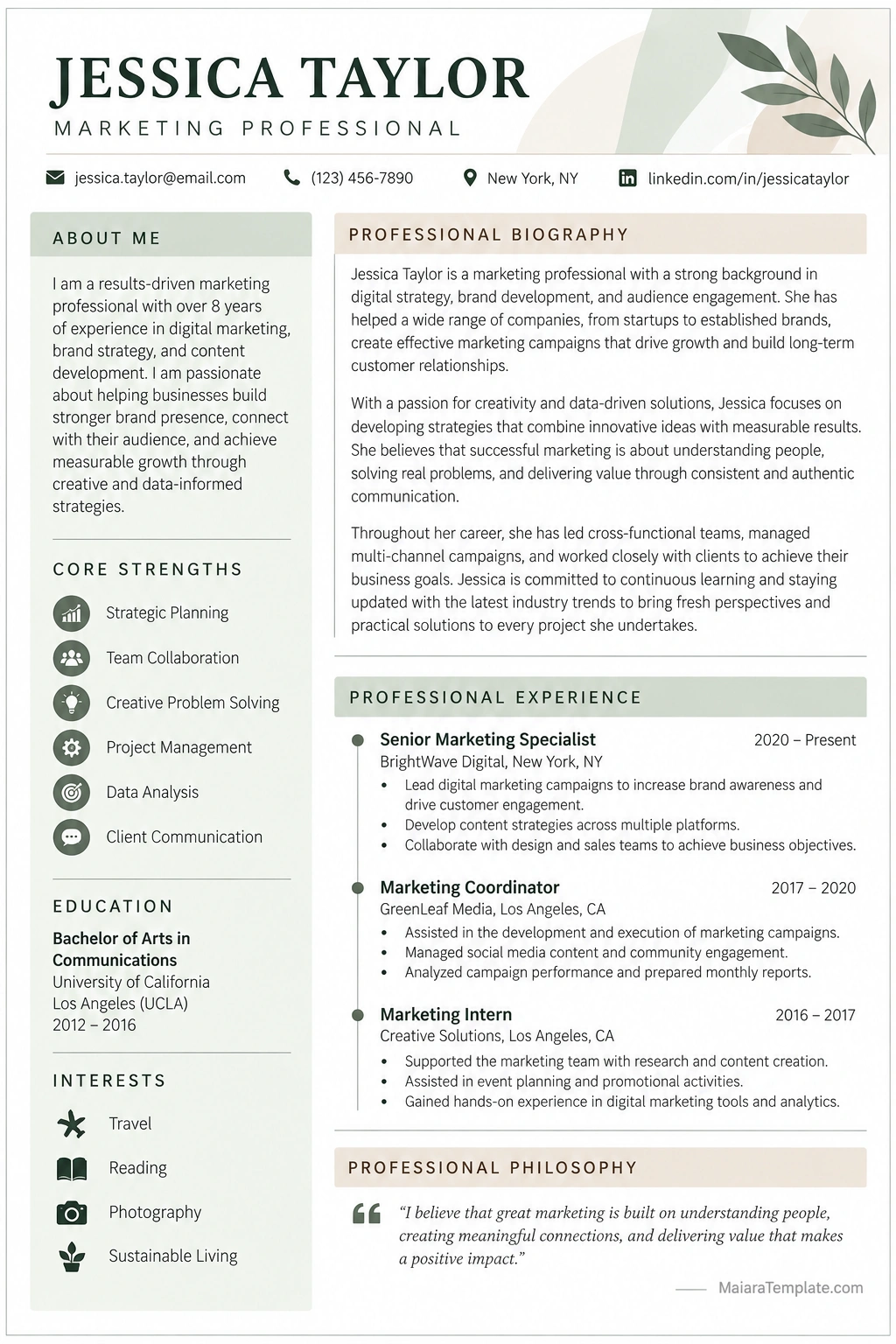
Use the sample as a reference rather than copying every section. Customize the layout to reflect your profession, experience, and audience. For example, a recent graduate may emphasize education and projects, while an experienced consultant may highlight client work and business achievements.
Common Professional Biography Mistakes to Avoid
Even a qualified professional can struggle to communicate their experience effectively. Avoid these common mistakes when writing your biography.
- Including too much information: Focus on relevant experience instead of describing every role you have held.
- Using vague claims: Replace phrases such as “highly successful professional” with specific experience or accomplishments.
- Writing in an unsuitable tone: Match your style to your industry and audience.
- Repeating your resume: Use the biography to provide context and highlight your professional identity rather than listing every resume entry.
- Exaggerating achievements: Present your qualifications and contributions accurately.
- Forgetting to proofread: Check names, grammar, spelling, job titles, and dates before publishing.
- Leaving outdated information online: Review your biography when your role, qualifications, or professional focus changes.
Frequently Asked Questions About Professional Biographies
What is the purpose of a professional biography?
A professional biography introduces your background, expertise, and selected achievements. It helps employers, clients, colleagues, and other readers understand your professional identity and experience.
How long should a professional biography be?
The ideal length depends on its purpose. A short bio may contain approximately 50 to 100 words, while a website or company biography may use 150 to 300 words or more. Follow any length requirements provided by the organization or publication.
Should a professional biography be written in first person or third person?
Both styles can work. First person often feels personal and direct, making it suitable for personal websites and informal profiles. Third person is common for company websites, conference speakers, and formal professional introductions.
What is the difference between a professional biography and a resume?
A professional biography presents selected career information in narrative form, while a resume organizes employment history, qualifications, and skills into structured sections. A biography provides context, whereas a resume offers a more detailed record of professional experience.
Can a professional biography be used on LinkedIn?
Yes. A professional biography can help you develop the introductory content for your LinkedIn profile. Adapt the wording to the platform and emphasize the skills, experience, and achievements relevant to your career goals.
Should I include personal interests in a professional biography?
You can include a relevant personal interest if it adds useful context or helps readers connect with you. However, prioritize professional information unless the intended audience or format calls for a more personal introduction.
How often should I update my professional biography?
Review your biography whenever you change roles, earn a significant qualification, complete an important project, or develop a new area of expertise. A periodic review helps ensure that your biography accurately reflects your current work.
Conclusion
A professional biography helps communicate your experience, expertise, achievements, and professional identity in a concise and engaging way. It can support career development, strengthen your personal brand, and make it easier for potential employers, clients, and collaborators to understand your value.
To write an effective biography, identify your audience, introduce your role clearly, select relevant experience, and highlight meaningful achievements. Use accurate information, maintain a suitable tone, and edit your writing to remove unnecessary details.
A well-organized professional biography sample can provide a helpful starting point, but the strongest biography is one that reflects your actual background and goals. Customize the content to suit your profession, update it as your career develops, and use it consistently across relevant professional platforms.
Download: Professional Biography Template

- Professional Biography Template (Word) - October 27, 2026
- Consulting Billing Invoice Template - October 27, 2026
- Freelance Billing Invoice Template - October 27, 2026
