A skill-based resume is a resume format that emphasizes skills, abilities, achievements, and qualifications rather than placing primary attention on chronological work history. This format can be useful for job seekers who want to highlight transferable skills, career-related abilities, and relevant accomplishments.
Unlike a traditional chronological resume, a skill-based resume organizes information around what you can do and how your abilities relate to the position you want. This can make it easier for an employer to identify relevant qualifications, especially when your previous job titles do not closely match the role you are applying for.
A skill-based resume can be particularly useful for recent graduates, career changers, people returning to the workforce, freelancers, and applicants whose previous experience does not directly match their target position.
What Is a Skill-Based Resume?
A skill-based resume, also called a functional resume, focuses primarily on relevant skills and accomplishments instead of presenting employment history as the main section.
The goal is to show an employer what you can contribute to the position. Instead of simply listing job responsibilities under each employer, you can group your strongest qualifications into skill categories and support them with specific examples.
A skill-based resume may include sections such as:
- Contact information
- Professional summary
- Core skills
- Relevant achievements
- Skills in action
- Education
- Certifications
- Additional experience
Your employment history can still be included. However, it does not necessarily need to dominate the resume.
Skill-Based Resume Template
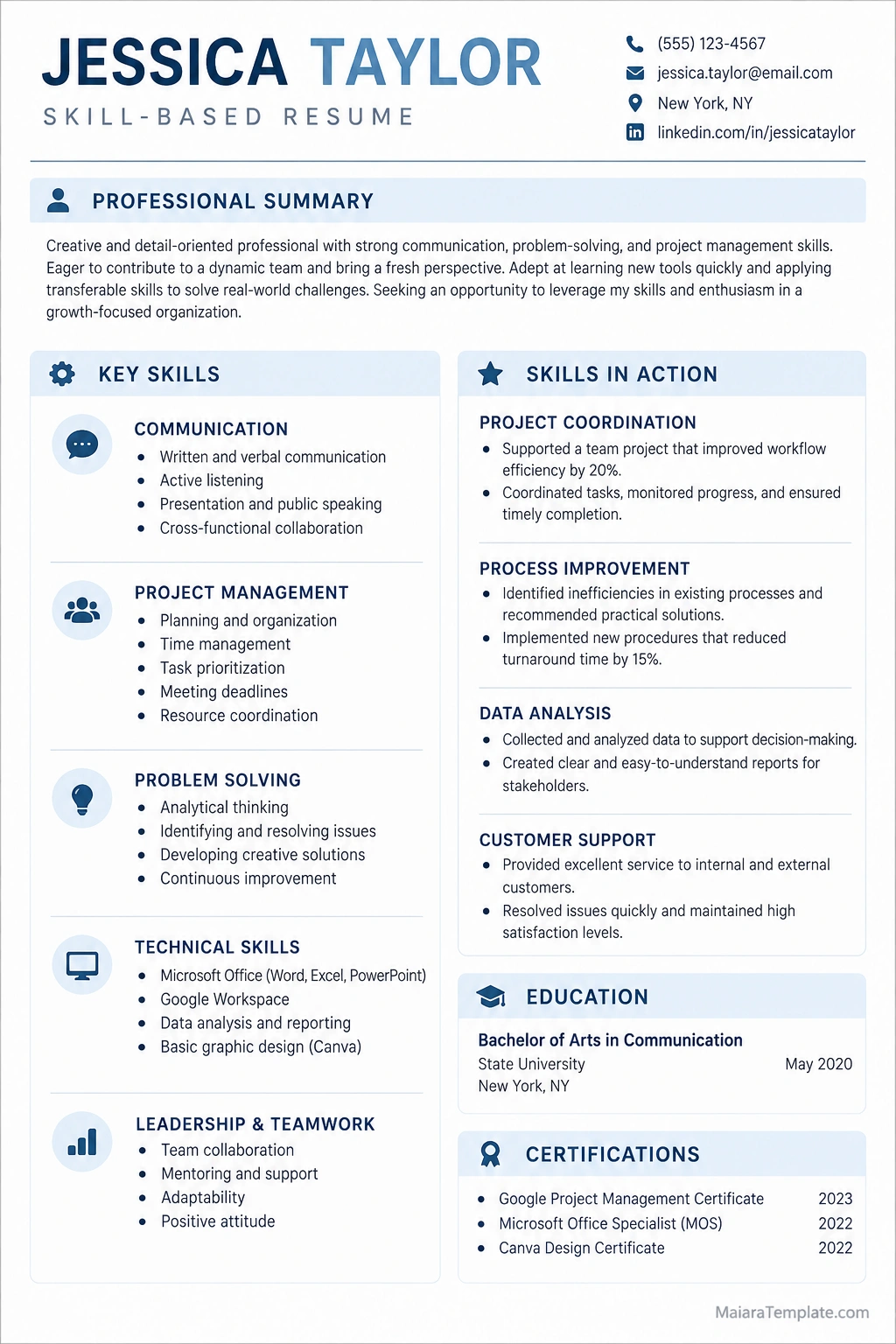
A skill-based resume template gives you a structured starting point for presenting your qualifications around your abilities and accomplishments. It can be especially useful when your strongest qualifications come from different jobs, education, volunteer work, freelance projects, or other experiences.
The example below uses sections for a professional summary, key skills, skills in action, education, and certifications. The skill categories can be changed to match the requirements of the position you are targeting.
Who Should Use a Skill-Based Resume?
A skill-based resume can be helpful when your work history does not tell the full story of your qualifications. It allows you to bring relevant abilities to the forefront of the document.
Recent Graduates
Recent graduates may have limited professional experience but can have valuable skills gained through coursework, internships, projects, volunteer activities, student organizations, and part-time work.
Career Changers
If you are moving from one profession to another, your previous job titles may not immediately demonstrate your suitability for the new field. A skills-focused resume can connect transferable abilities with the requirements of your target role.
People Returning to the Workforce
Applicants with an employment gap may prefer to emphasize current skills, achievements, education, certifications, and other relevant experience rather than making the employment timeline the central feature of the resume.
Freelancers and Contractors
Freelancers may have worked on numerous projects for different clients. Grouping accomplishments by skill can sometimes provide a clearer picture of their capabilities than listing every short-term engagement chronologically.
Applicants With Diverse Experience
If your background includes different industries or types of work, a skill-based format can help organize related abilities into meaningful categories.
Skill-Based Resume vs. Chronological Resume
The main difference between the two formats is how professional information is organized.
A chronological resume generally emphasizes employment history, with positions presented in chronological order, usually starting with the most recent role.
A skill-based resume emphasizes relevant abilities and accomplishments. Employment history may appear later or in a shorter section.
For example, a chronological resume might organize experience like this:
- Marketing Coordinator — Company A
- Customer Service Representative — Company B
- Administrative Assistant — Company C
A skill-based resume might instead organize relevant experience under categories such as:
- Project Coordination
- Customer Communication
- Data Analysis
- Process Improvement
The best format depends on your background, target position, and the information you need an employer to notice first.
What to Include in a Skill-Based Resume
A strong skill-based resume should provide enough information for an employer to understand both your abilities and the evidence supporting them.
Contact Information
Include your name, phone number, professional email address, location, and relevant professional profile or portfolio link when appropriate.
Professional Summary
Write a short summary that introduces your strongest qualifications and connects them to the position you want. Focus on relevant abilities rather than using generic statements.
Core Skills
Create a focused list of skills that are relevant to the target job. These may include technical skills, communication skills, leadership, project management, customer service, research, data analysis, or other job-specific abilities.
Skills in Action
This section is particularly important because simply listing skills does not demonstrate proficiency. Support important skills with examples of how you used them and what you accomplished.
Education
Include relevant degrees, diplomas, coursework, academic projects, or other educational qualifications. Recent graduates may place education more prominently than experienced professionals.
Certifications
List relevant certifications that support your qualifications. Include the certification name and issuing organization when useful.
Additional Experience
You can include employment, volunteer work, internships, freelance projects, community involvement, or other experiences that demonstrate relevant skills.
How to Write a Skill-Based Resume
Creating a skills-focused resume becomes easier when you start with the job rather than with your previous job titles.
1. Identify the Target Position
Start by identifying the specific type of role you want. Read the job description carefully and note the skills, qualifications, tools, and responsibilities emphasized by the employer.
2. Identify Your Relevant Skills
Make a list of skills that relate directly to the position. Separate highly relevant skills from abilities that are less important for the particular job.
3. Group Related Skills
Organize related abilities into logical categories. For example, a project coordinator might use categories such as project management, communication, organization, scheduling, and technical tools.
4. Add Evidence
For each major skill category, provide examples that demonstrate how you used the skill. Whenever possible, include measurable outcomes.
5. Write a Targeted Summary
Your professional summary should quickly communicate your strongest qualifications and explain the value you can bring to the target role.
6. Add Your Employment History
Even when skills are the focus, include relevant employment information when possible. Keep the section concise if the chronological details are not central to your application.
7. Review the Resume for Relevance
Remove information that does not support your application. A focused resume makes it easier for employers to identify your most relevant qualifications.
How to Highlight Transferable Skills
Transferable skills are abilities that can be applied across different jobs, industries, or professional environments. They can be especially important for career changers and applicants with nontraditional backgrounds.
Examples of transferable skills include:
- Communication
- Leadership
- Problem solving
- Project coordination
- Time management
- Teamwork
- Organization
- Customer service
- Research
- Data analysis
- Adaptability
- Conflict resolution
Instead of simply listing these abilities, explain how you used them. For example, rather than writing “strong project management skills,” describe a project you coordinated, the responsibilities you handled, and the measurable result.
How to Write Strong Skill Statements
Strong skill statements connect an ability with an action and a result. This makes the resume more specific and credible.
Use Action Verbs
Begin achievement statements with clear action verbs such as managed, coordinated, developed, analyzed, improved, organized, created, implemented, trained, or resolved.
Include Measurable Results
Numbers can make accomplishments more concrete. When accurate, include information such as percentages, revenue, time saved, number of customers served, project size, or productivity improvements.
Focus on Results
Do not only explain what you were responsible for. Show what happened because you performed the work.
For example:
- Weak: Responsible for organizing team projects.
- Stronger: Coordinated project tasks and deadlines across a five-person team, helping complete a client project two weeks ahead of schedule.
Skill-Based Resume for Career Changers
A skill-based resume can help career changers explain how previous experience relates to a new professional direction.
For example, someone moving from retail management into office administration might highlight:
- Team leadership
- Scheduling
- Customer communication
- Inventory management
- Problem solving
- Administrative organization
The applicant can then provide examples showing how these abilities were developed and used in previous positions.
This approach helps connect past experience with the requirements of a new career without pretending that the previous role was identical to the target position.
Tips for Making a Skill-Based Resume Effective
- Tailor the skills section to every important job application.
- Use keywords that accurately reflect the job description.
- Support important skills with specific examples.
- Use measurable achievements when available.
- Keep the most relevant skills near the top of the resume.
- Avoid listing skills you cannot demonstrate.
- Keep the formatting clean and easy to scan.
- Include employment history rather than completely hiding your work background.
- Proofread the resume carefully before submitting it.
- Keep the information accurate and consistent throughout the document.
Common Skill-Based Resume Mistakes
Listing Skills Without Evidence
A long list of skills does not necessarily demonstrate ability. Whenever possible, connect important skills to specific projects, achievements, responsibilities, or results.
Using Generic Skills
Terms such as “hard worker” or “team player” provide limited information without context. Use specific skills that relate to the target position and demonstrate them through examples.
Hiding Employment History Completely
A skill-based resume does not require you to eliminate your work history. Employers may still need to understand where and when you gained your experience.
Using the Same Resume for Every Job
Different positions require different skills. Adjust your summary, skill categories, and achievement examples to match each relevant job opportunity.
Overloading the Resume With Text
Even a skills-focused resume should be easy to scan. Use concise statements, clear headings, bullet points, and consistent formatting.
Skill-Based Resume Keywords
Relevant keywords can help employers quickly identify qualifications that match the position. Review the job description and naturally incorporate accurate terms that describe your experience.
Depending on the role, these may include terms such as:
- Project management
- Customer relationship management
- Data analysis
- Microsoft Excel
- Communication
- Team leadership
- Process improvement
- Digital marketing
- Research
- Problem solving
Use keywords honestly. A resume should reflect skills you actually possess rather than simply copying terminology from a job advertisement.
Frequently Asked Questions About Skill-Based Resumes
What is a skill-based resume?
A skill-based resume is a resume format that emphasizes skills, competencies, and achievements rather than making chronological employment history the primary focus.
Who should use a skill-based resume?
Skill-based resumes can be useful for recent graduates, career changers, people returning to the workforce, freelancers, and applicants with diverse or nontraditional experience.
Is a skill-based resume the same as a functional resume?
The terms are often used interchangeably. Both formats generally emphasize skills and accomplishments rather than organizing the resume primarily around chronological employment history.
Should a skill-based resume include work experience?
Yes. A skill-based resume can include employment history while placing greater emphasis on relevant skills and achievements. Providing accurate work history can help employers understand the background behind your qualifications.
How long should a skill-based resume be?
The appropriate length depends on your experience and the requirements of the position. Keep the resume focused and include enough information to demonstrate your relevant qualifications without unnecessary detail.
What skills should I put on a skill-based resume?
Include skills that are relevant to the target position and that you can support with actual experience. These may include technical skills, communication, leadership, organization, project management, analysis, customer service, or other job-specific abilities.
Can a recent graduate use a skill-based resume?
Yes. Recent graduates can emphasize skills gained through education, internships, academic projects, volunteer work, part-time employment, certifications, and extracurricular activities.
Can a skill-based resume help with a career change?
Yes. It can help organize transferable skills that connect previous experience with the requirements of a new profession. The resume should still provide accurate information about the applicant’s background.
Conclusion
A skill-based resume puts the focus on what you can do, what you have accomplished, and how your abilities relate to the position you want. It can be a useful format for career changers, recent graduates, returning professionals, freelancers, and applicants whose chronological work history does not fully communicate their qualifications.
The key is to go beyond simply listing skills. Organize relevant abilities into clear categories, support them with specific examples, highlight measurable achievements when possible, and tailor the content to the target position.
With a well-structured skill-based resume template, you can present your transferable skills and accomplishments in a clear format that helps employers understand your qualifications and professional value.
Download: Skill-Based Resume Template

- Printable Wedding Guest List Template - October 1, 2026
- Free Printable Trip Schedule Template - October 1, 2026
- Free Printable Table Card Template - October 1, 2026
