A SOAP note is a structured method of documenting a patient encounter using four sections: Subjective, Objective, Assessment, and Plan. This format helps healthcare professionals organize information consistently, communicate important clinical details, and create a clear record of the patient’s condition and care plan.
By separating what the patient reports from what the healthcare professional observes, interprets, and plans next, a SOAP note provides a logical framework for documenting an encounter. It can support continuity of care when multiple members of a healthcare team need to understand what happened during a visit.
SOAP notes are widely used in clinical documentation, but documentation requirements can vary by profession, organization, payer, jurisdiction, and electronic health record system. Healthcare professionals should follow the standards and policies that apply to their specific setting.
What Is a SOAP Note?
A SOAP note is a clinical documentation format designed to organize information from a patient encounter into four distinct sections. The acronym SOAP stands for Subjective, Objective, Assessment, and Plan.
Each section serves a different purpose. Subjective information records what the patient reports. Objective information documents observable or measurable findings. Assessment records the clinician’s interpretation of the available information. Plan describes the next steps in care.
This structure creates a logical progression from the patient’s reported experience to clinical findings, professional assessment, and planned care.
What Does SOAP Stand For?
Subjective
The Subjective section contains information reported by the patient or another relevant source. It may describe symptoms, concerns, history, changes since a previous visit, and the patient’s experience of the problem.
Examples may include the patient’s description of pain, reported symptoms, concerns about treatment, or information about how a condition has changed.
Objective
The Objective section records information that can be observed, measured, examined, or otherwise verified by the healthcare professional or through available clinical data.
This may include vital signs, physical examination findings, laboratory results, imaging findings, measurements, or other relevant observations.
Assessment
The Assessment section contains the clinician’s professional interpretation of the subjective and objective information. It may include a diagnosis, clinical impression, progress assessment, or consideration of relevant differential diagnoses when appropriate.
The assessment connects the information collected during the encounter to the clinician’s clinical reasoning.
Plan
The Plan section explains what will happen next. Depending on the encounter, it may include treatment, medication decisions, additional testing, referrals, patient education, monitoring, follow-up, or other appropriate actions.
The plan should clearly communicate the intended next steps and any relevant instructions.
Why Are SOAP Notes Important?
Structured clinical documentation can provide several practical benefits for healthcare teams and patients.
- Improves organization: Information is separated into consistent categories.
- Supports communication: Other authorized members of the care team can more easily understand the encounter.
- Facilitates continuity of care: Future providers can review relevant information from previous encounters.
- Supports clinical reasoning: The format connects patient reports and clinical findings with assessment and planning.
- Creates a professional record: Documentation provides a record of the encounter and care decisions.
- Encourages consistency: A standardized structure can make documentation more predictable.
- Supports care planning: The plan section identifies intended next steps and follow-up.
Clinical documentation may also have professional, regulatory, billing, and legal implications. Requirements vary by healthcare setting, so documentation should follow applicable standards rather than relying solely on a generic SOAP note format.
What Should a SOAP Note Include?
A SOAP note should contain information relevant to the particular patient encounter. The level of detail will depend on the clinical situation, the profession, and applicable documentation requirements.
Patient Information
Depending on the documentation system, identifying information may appear at the beginning of the note. This can include the patient’s name or identifier, date of the encounter, provider information, and other required administrative details.
Chief Complaint
The chief complaint can briefly identify the primary reason for the encounter. It provides context for the information documented in the SOAP note.
Relevant History
When relevant to the encounter, the subjective section may include information about the history of the present illness, previous conditions, medications, allergies, family history, social history, or other patient-reported information.
Clinical Findings
The objective section should contain relevant findings rather than unnecessary information. Depending on the situation, this can include vital signs, examination findings, test results, measurements, or observations.
Clinical Assessment
The assessment should summarize the clinician’s interpretation of the information collected. It should distinguish clinical interpretation from information that belongs in the subjective or objective sections.
Care Plan
The plan should document appropriate next steps. It may include treatment decisions, tests, referrals, education, follow-up, monitoring, or other actions relevant to the patient’s care.
How to Write a SOAP Note
Writing an effective SOAP note starts with collecting relevant information and then placing it in the appropriate section.
1. Start With the Patient’s Report
Begin with the information the patient provides. Record relevant symptoms, concerns, history, and changes in the patient’s own experience. Use clear and objective documentation rather than adding assumptions.
2. Record Objective Findings
Document relevant measurements, examination findings, observations, and test results. Be specific when the information is measurable or otherwise verifiable.
3. Develop the Assessment
Use the subjective and objective information to document the appropriate clinical assessment. The assessment should reflect professional judgment based on the information available during the encounter.
4. Document the Plan
Record the intended next steps clearly. Include relevant treatments, tests, referrals, education, monitoring, and follow-up instructions according to the clinical situation.
5. Review the Note
Before finalizing the documentation, check that the information is accurate, relevant, complete according to applicable requirements, and placed in the appropriate section.
SOAP Note Example Structure
A simple SOAP note structure might look like this:
- Subjective: Patient reports the primary concern, relevant symptoms, and changes since the previous encounter.
- Objective: Document relevant vital signs, examination findings, measurements, and test results.
- Assessment: Record the clinician’s interpretation, diagnosis, or clinical impression as appropriate.
- Plan: Document treatment, testing, education, referrals, monitoring, and follow-up.
This structure is intentionally general. A real clinical note should contain the information appropriate to the specific encounter and the documentation standards applicable to the healthcare professional.
SOAP Note vs. Other Clinical Documentation Formats
SOAP is one of several approaches to clinical documentation. Different organizations and healthcare professionals may use different formats depending on their workflow and requirements.
SOAP Note
SOAP organizes documentation into Subjective, Objective, Assessment, and Plan. Its four-part structure provides a straightforward framework for connecting patient information to clinical reasoning and next steps.
DAP Note
DAP generally refers to Data, Assessment, and Plan. It combines information about the encounter into a different structure and is used in some clinical settings.
BIRP Note
BIRP generally refers to Behavior, Intervention, Response, and Plan. It is another documentation structure that may be used in behavioral health and related settings.
The appropriate format depends on the professional setting, organization, documentation requirements, and purpose of the record.
Common SOAP Note Mistakes
Even when using a standardized format, documentation can become less useful when information is vague, incomplete, or placed in the wrong section.
- Using vague descriptions: Provide relevant details rather than broad statements that do not explain the encounter.
- Mixing subjective and objective information: Keep patient-reported information separate from observed or measured findings.
- Writing an unclear assessment: The assessment should communicate the clinician’s interpretation clearly.
- Leaving the plan too general: Document relevant next steps with enough detail to support continuity of care.
- Including unnecessary information: Focus on information relevant to the encounter and applicable documentation requirements.
- Using unexplained abbreviations: Follow the terminology and abbreviation standards required by the organization or profession.
- Failing to review the note: Check for accuracy, completeness, and consistency before finalizing documentation.
Tips for Writing Better SOAP Notes
A consistent documentation routine can make SOAP notes easier to prepare while improving their usefulness for subsequent care.
- Use clear, professional language.
- Focus on information relevant to the encounter.
- Separate patient-reported information from clinical findings.
- Document measurable findings accurately.
- Connect the assessment to the information available.
- Make the plan clear enough for appropriate follow-up.
- Use consistent terminology throughout the record.
- Follow your organization’s documentation policies.
- Protect patient privacy and use appropriate information-handling procedures.
- Review the completed note before signing or finalizing it.
Using a SOAP Note Template
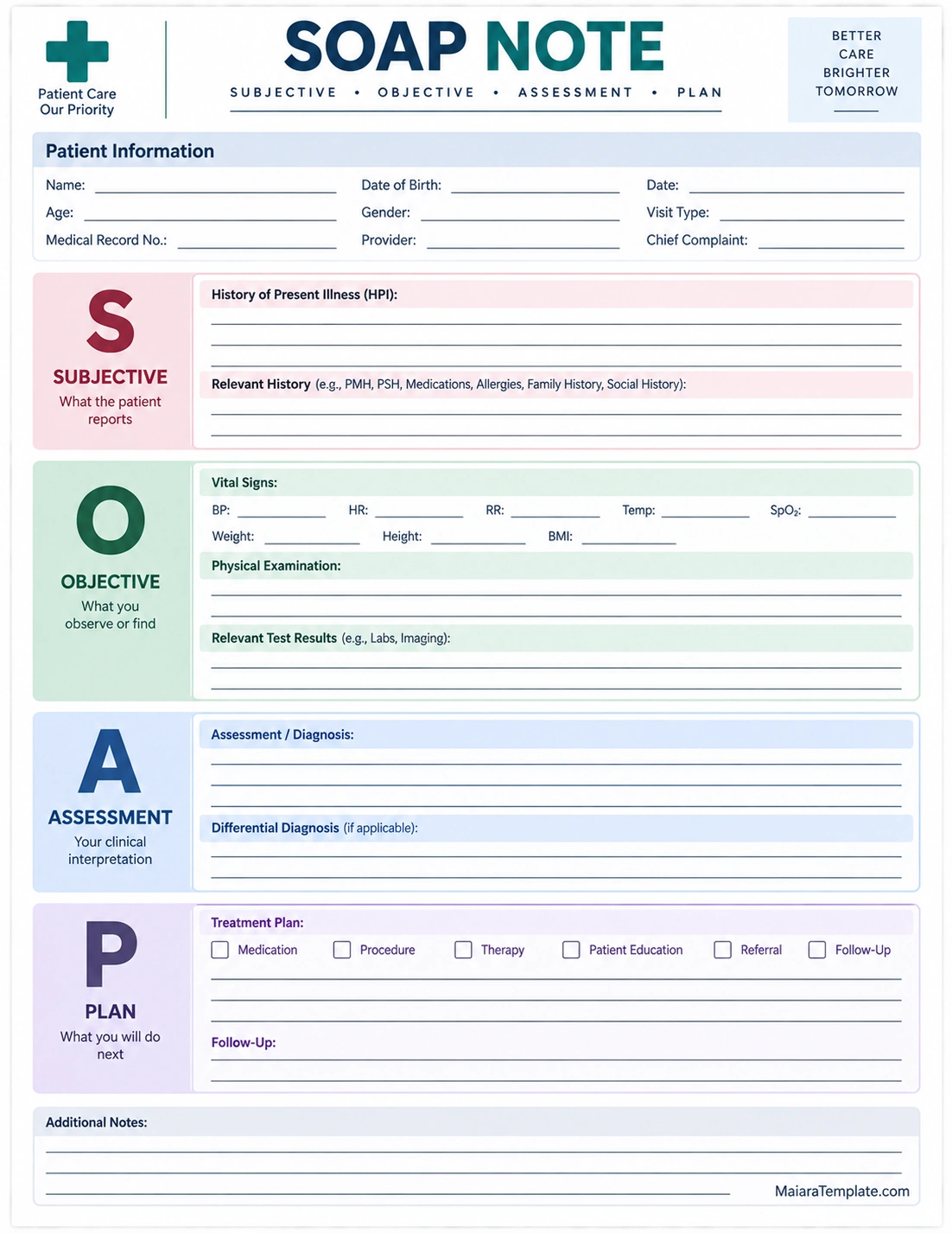
A SOAP note template provides a predefined structure for documenting patient encounters. Instead of creating the four sections from scratch, healthcare professionals can use designated areas for Subjective, Objective, Assessment, and Plan information.
A printable SOAP note template can be useful in settings where paper documentation is appropriate or when a clinician wants a structured worksheet for organizing information before entering it into an electronic health record.
A well-designed template may include patient information, date, provider details, chief complaint, subjective notes, objective findings, assessment, treatment plan, follow-up, and additional notes.
Templates should be adapted to the specific clinical setting and should not replace applicable organizational, professional, regulatory, or legal documentation requirements.
SOAP Note Checklist
Before finalizing a SOAP note, review the following checklist:
- Patient and encounter information is correct.
- The reason for the encounter is documented when applicable.
- Relevant subjective information is included.
- Relevant objective findings are recorded.
- Measurements and test results are documented accurately.
- The assessment reflects the available clinical information.
- The plan identifies appropriate next steps.
- Follow-up information is included when applicable.
- Unnecessary or unrelated information has been avoided.
- The documentation follows applicable professional and organizational requirements.
- The completed note has been reviewed for accuracy.
Final Thoughts
A SOAP note provides a practical framework for organizing clinical documentation into four connected sections: Subjective, Objective, Assessment, and Plan. By separating patient-reported information, clinical findings, professional interpretation, and planned care, the format can make patient records easier to understand and review.
A consistent SOAP note structure can support communication among authorized members of a care team, continuity of care, and organized clinical reasoning. A printable SOAP note template can make documentation more convenient by providing clearly defined spaces for each part of the encounter.
Because documentation requirements differ across healthcare professions and settings, a generic template should always be adapted to the applicable policies, standards, and requirements of the organization and jurisdiction where it is used.
Download: SOAP Note Template

- Free Weekly Sales Report Template - September 23, 2026
- Free Printable Weekly Food Chart Template - September 23, 2026
- Staff Confidentiality Agreement Template (Word) - September 23, 2026
