A Trading Journal is a practical tool for recording, reviewing, and analyzing your trades. Instead of relying on memory or emotions, traders can use a journal to document important information such as entry and exit prices, position size, trading strategy, profit or loss, market conditions, and emotional state. Over time, these records can reveal patterns that are difficult to recognize when looking at individual trades.
A well-maintained trading journal is useful for both new and experienced traders. It can help you identify which setups you follow consistently, understand why certain trades perform differently, and recognize habits that may be affecting your results. The goal is not simply to record whether a trade was profitable. The real value comes from reviewing the decision-making process behind each trade and using the information to make future trading plans more consistent and data-driven.
What Is a Trading Journal?
A Trading Journal is a structured record of your trading activity. It can be maintained in a notebook, spreadsheet, printable worksheet, or digital trading journal. The format may vary, but the purpose remains the same: to create a reliable record of what you planned, what you did, what happened, and what you learned.
A basic journal may record only entry price, exit price, position size, and profit or loss. A more detailed trading journal can include the trading setup, timeframe, market conditions, stop-loss level, take-profit target, risk-to-reward ratio, emotions, and lessons learned.
The more consistently you record relevant information, the easier it becomes to evaluate your trading behavior over a meaningful sample of trades.
Why Should Traders Keep a Trading Journal?
Trading involves decisions under uncertainty. A single winning or losing trade does not necessarily tell you whether your strategy is working. A journal allows you to collect information across many trades so you can evaluate your process instead of focusing only on individual outcomes.
Identify Trading Patterns
Reviewing multiple trades can help you find recurring patterns. For example, you may discover that certain setups perform better during specific market conditions or that your results change when you trade outside your normal timeframe.
These observations can provide useful information for refining a trading plan.
Measure Strategy Performance
A trading journal makes it easier to compare different strategies and setups. Instead of judging a strategy based on a few memorable trades, you can review a larger collection of documented results.
Useful measurements may include win rate, average profit, average loss, risk-to-reward ratio, total profit or loss, and the number of trades taken.
Improve Trading Discipline
Recording every trade creates accountability. When traders know they will have to document why they entered and exited a position, they may become more deliberate about following their trading plan.
This can be particularly useful for identifying trades that were taken because of impatience, fear of missing out, frustration, or other emotional reactions.
Learn From Losing Trades
A losing trade is not automatically a bad trade, just as a profitable trade is not automatically a good trade. A trade can lose money even when the original plan was reasonable, while a trade can make money despite poor execution.
A journal helps separate the quality of the decision from the financial outcome. This distinction can make post-trade analysis more objective.
What Should You Record in a Trading Journal?
A useful journal should contain enough information to reconstruct the trade later. However, it should not be so complicated that recording every trade becomes a burden.
Consider including the following information:
- Date and time: Record when the trade was entered and exited.
- Instrument or symbol: Identify the stock, currency pair, cryptocurrency, option, or other asset.
- Market: Record the market or asset class being traded.
- Trade direction: Specify whether the position was long or short.
- Trading strategy: Identify the setup or strategy used.
- Timeframe: Record the chart timeframe used for the decision.
- Entry price: Document the actual entry price.
- Exit price: Record the actual exit price.
- Position size: Document the number of shares, contracts, units, or other position measurements.
- Stop loss: Record the planned risk limit.
- Take profit: Record the intended target when applicable.
- Risk-to-reward ratio: Document the planned relationship between potential loss and potential gain.
- Profit or loss: Record both the monetary and percentage result when useful.
- Emotions: Note your emotional state before, during, and after the trade.
- Lessons learned: Write down what worked and what could be improved.
Not every trader needs to track every possible metric. Start with information that directly supports your trading plan and add additional fields when they provide useful insight.
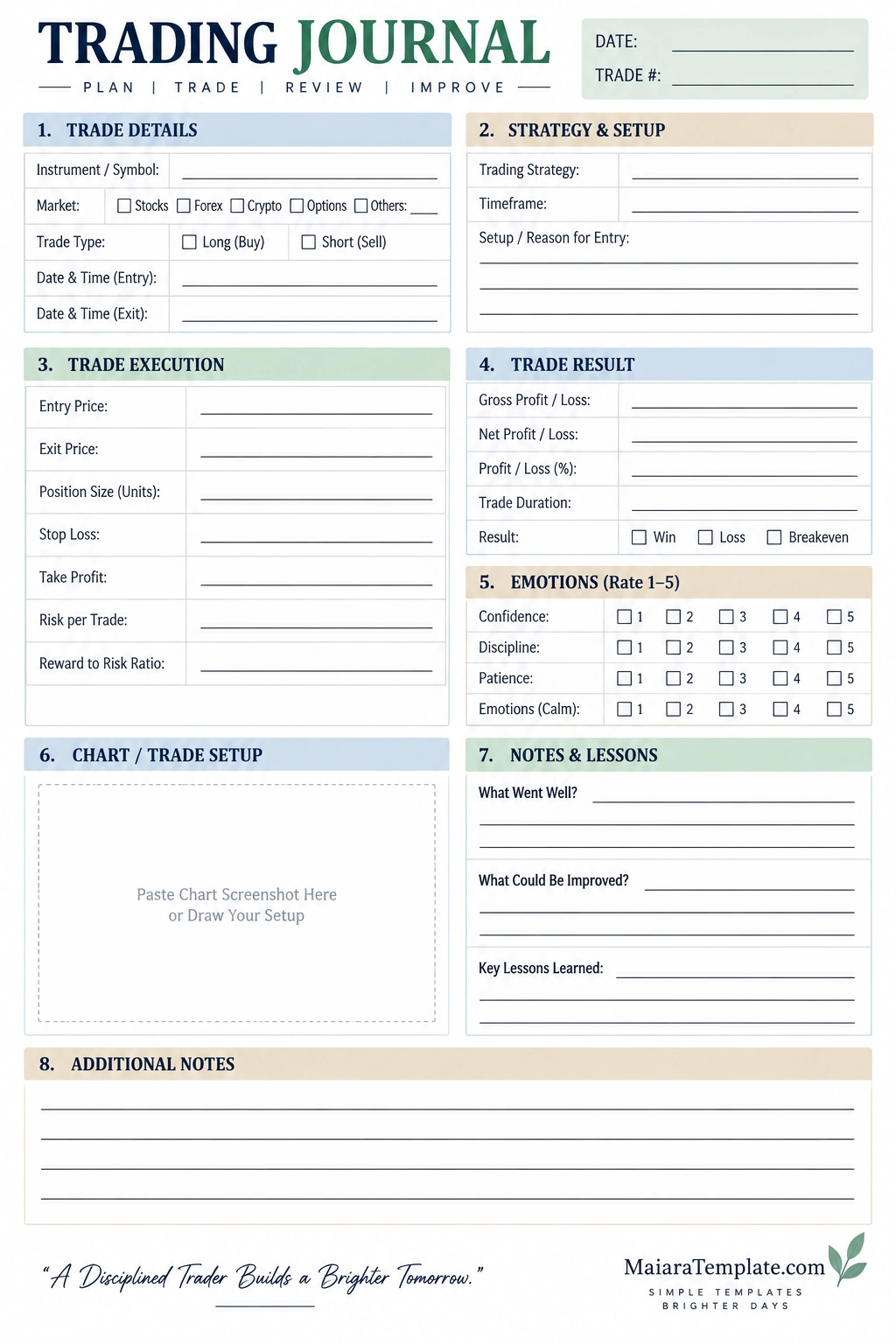
Key Sections of a Trading Journal Template
Trade Details
The trade details section provides basic information about the position. Record the instrument, market, trade direction, date, and entry and exit times.
This information makes it easier to organize your records and identify whether certain instruments, sessions, or trading periods produce different results.
Strategy and Setup
Record the strategy or setup that caused you to consider the trade. You can also describe the technical or fundamental reasons behind the entry.
For example, a trader might document a breakout, trend continuation, support or resistance setup, moving-average signal, earnings-related setup, or another predefined trading condition.
The important point is to record the actual reason for entering rather than creating an explanation after the trade has already finished.
Trade Execution
The execution section records the practical details of the position. This may include entry price, exit price, position size, stop-loss level, take-profit target, and planned risk.
Comparing planned values with actual execution can reveal problems such as entering too early, exiting too soon, moving a stop loss, or increasing position size without a predefined reason.
Trade Result
Record the financial outcome of the trade. Depending on your trading style, useful metrics may include gross profit or loss, net profit or loss, percentage return, and trade duration.
It can also be useful to categorize each trade as a win, loss, or breakeven result. Over a larger sample, these records can support more meaningful performance analysis.
Emotional Review
Emotions can influence trading decisions, particularly when markets move quickly. A journal can provide a structured place to record confidence, discipline, patience, fear, excitement, frustration, or other emotions relevant to your decision-making.
Try to record your emotional state honestly rather than writing what you think you should have felt. Accurate observations are more useful during later reviews.
Chart or Trade Setup
Adding a chart screenshot or drawing of the setup can make your journal much more useful. Visual records allow you to review what the market looked like when you made the decision.
Over time, a collection of chart examples can help you compare successful setups with unsuccessful ones and identify recurring characteristics.
Notes and Lessons
After closing the trade, write a short review. Ask yourself what went well, what could have been improved, and what lesson should be carried into the next trade.
Keep the review focused on actionable observations. Instead of writing “I traded badly,” identify the specific behavior that needs attention, such as entering without confirmation or closing the position outside the original plan.
How to Use a Trading Journal Effectively
Creating a journal is only the first step. The greatest benefit comes from using it consistently and reviewing the information regularly.
Record Trades Immediately
Enter the important details as close to the trade as practical. Waiting several days can cause you to forget the reasoning, market conditions, or emotions associated with the position.
Write Down the Plan Before Entering
Whenever possible, record the intended entry, stop loss, target, position size, and reason for the trade before entering the position. This creates a record of your original plan that can later be compared with what actually happened.
Review Trades Regularly
Set aside time to review your journal. A weekly or monthly review can help you identify patterns that are not obvious when analyzing one trade at a time.
During the review, look for repeated behaviors such as:
- Taking trades outside your strategy
- Entering because of fear of missing out
- Closing profitable trades too quickly
- Allowing losing positions to remain open longer than planned
- Changing stop-loss levels without a predefined rule
- Trading larger positions after a loss
- Overtrading after several consecutive trades
Separate Strategy From Execution
When reviewing performance, distinguish between whether the setup was valid and whether you executed it according to plan. This prevents you from abandoning a potentially useful setup simply because of one unfavorable outcome.
Similarly, a profitable trade should still be reviewed if the execution violated your trading rules.
Trading Journal Metrics to Track
A journal can contain both qualitative notes and numerical data. Quantitative metrics can help you evaluate performance over time, although no single metric provides a complete picture.
- Win rate: The percentage of recorded trades that close profitably.
- Average winning trade: The average gain among profitable trades.
- Average losing trade: The average loss among losing trades.
- Profit factor: A comparison of gross profits with gross losses.
- Average risk-to-reward ratio: The relationship between planned risk and potential reward.
- Maximum drawdown: The largest decline in account value over a defined period.
- Trade frequency: The number of trades taken during a particular period.
- Average trade duration: The typical amount of time positions remain open.
These metrics should be interpreted within the context of the specific strategy, market, timeframe, and sample size. A small number of trades may not provide enough information to draw reliable conclusions.
Common Trading Journal Mistakes
One common mistake is recording only profitable trades. Doing so creates an incomplete record and makes it difficult to understand the actual performance of a strategy.
Another mistake is keeping the journal too complicated. If recording one trade takes too much time, you may eventually stop maintaining it. A simple and consistent system is often more practical than a highly detailed journal that is rarely completed.
It is also important to avoid changing your records after seeing the outcome. The purpose of the journal is to preserve what you knew and believed at the time of the decision. Editing the original reasoning can reduce the usefulness of later analysis.
Printable Trading Journal vs. Digital Journal
A printable trading journal can be useful for traders who prefer handwriting their observations. A physical worksheet can also encourage a deliberate review process after each position.
A spreadsheet or digital trading journal, on the other hand, makes it easier to calculate statistics, filter trades, sort setups, and analyze larger datasets.
There is no requirement to use one format exclusively. Some traders may use a printable worksheet for detailed trade notes and a spreadsheet for long-term performance statistics.
How a Trading Journal Can Improve Your Trading Process
The primary purpose of journaling is not to predict the next trade. Instead, it helps you understand your own process.
For example, your records may show that you follow your rules consistently when trading your primary setup but frequently deviate from them when the market becomes highly volatile. Another review may reveal that your planned risk is consistent while your actual position sizes vary considerably.
These observations provide specific areas for improvement. Rather than making broad changes based on frustration after a losing trade, you can use documented evidence to decide which part of your process deserves attention.
Final Thoughts
A Trading Journal turns individual trades into a structured source of information. By recording your strategy, execution, results, emotions, and lessons, you create a record that can help you understand both your trading system and your behavior.
The most effective journal is one that you will actually use. Start with essential information, record every trade consistently, and review the results on a regular schedule. Over time, your journal can become a valuable tool for identifying recurring mistakes, measuring performance, improving discipline, and making your trading process more systematic.
Remember that journaling does not guarantee profitable trading. It is a decision-making and self-review tool that can help you evaluate your process using your own trading data rather than relying entirely on memory or emotion.
Trading Journal Template – Download

- Free Printable Time Log Template - September 17, 2026
- Free Printable Shipping Label Template - September 17, 2026
- Thank You Letter Template for a Job Offer - September 17, 2026
