Managing your money becomes easier when you have a clear plan for every month. A Month-to-Month Budget Planner helps you organize your income, track expenses, monitor savings, and manage debt payments throughout the year. Instead of guessing where your money goes, you can make informed financial decisions based on your actual spending habits.
Whether you want to reduce unnecessary expenses, build an emergency fund, or save for a future purchase, a monthly budget planner gives you a practical way to stay organized. It also allows you to compare your planned budget with your actual spending and adjust your financial priorities as your circumstances change.
In this guide, you will learn how to use a month-to-month budget planner, what information to include, and how to create a budgeting routine that works throughout the year.
What Is a Month-to-Month Budget Planner?
A Month-to-Month Budget Planner is a financial worksheet designed to help you manage your money across individual calendar months. It typically includes sections for income, fixed expenses, variable expenses, savings, debt payments, and monthly balances.
Unlike a basic monthly expense tracker, an annual budget planner allows you to review multiple months in one place. You can identify spending patterns, prepare for upcoming bills, and see how your financial situation changes over time.
Most monthly budget worksheets include two important financial figures:
- Budgeted amount: The amount you expect to earn or spend during a particular month.
- Actual amount: The amount you really earn or spend after the month begins.
Comparing these figures helps you identify differences between your financial plan and real-life spending. You can then make adjustments before small budgeting problems become bigger challenges.
Key Sections of a Month-to-Month Budget Planner
A useful monthly budget template should be simple enough to complete regularly while providing enough detail to understand your finances. Here are the essential sections to include.
1. Monthly Income
Start by listing all the money you expect to receive during the month. Use your take-home income rather than your gross salary because taxes and other deductions have already been removed.
Common income sources include:
- Regular employment income or paychecks.
- Freelance and side business earnings.
- Rental income.
- Bonuses and commissions.
- Other recurring or occasional income.
If your income changes from month to month, use a conservative estimate. This helps prevent you from creating a spending plan that depends on money you may not receive.
2. Fixed Monthly Expenses
Fixed expenses are regular payments that generally remain the same or change very little each month. These expenses are often easier to predict and should be included before planning discretionary spending.
Examples include:
- Rent or mortgage payments.
- Electricity, water, and gas bills.
- Internet and phone services.
- Insurance premiums.
- Loan installments.
- Monthly subscriptions.
Review these expenses periodically. Canceling unused subscriptions or negotiating service costs may help free up money for savings and other financial priorities.
3. Variable Monthly Expenses
Variable expenses can change depending on your lifestyle, shopping habits, and monthly activities. They are important to monitor because small purchases can gradually increase your total spending.
Common variable expense categories include:
- Groceries and household supplies.
- Transportation and fuel.
- Dining out and coffee.
- Shopping and personal care.
- Entertainment and hobbies.
- Healthcare and miscellaneous expenses.
Review your previous spending records to estimate realistic amounts for these categories. Setting reasonable limits can help you avoid overspending without making your budget unnecessarily restrictive.
4. Savings and Debt Payments
A complete budget should include more than everyday expenses. It should also account for your financial goals and outstanding debts.
Consider tracking the following:
- Emergency fund contributions.
- Retirement savings.
- Investment contributions.
- Short-term savings goals.
- Credit card payments.
- Personal loans and other debt repayments.
Recording these amounts every month helps you see whether you are making consistent progress toward financial stability.
5. Budgeted vs. Actual Totals
This section allows you to compare your original spending plan with the amounts you actually earned and spent.
For example, if you budget $400 for groceries but spend $450, you have exceeded your planned amount by $50. If you budget $200 for entertainment but spend only $150, you have $50 remaining in that category.
Tracking these differences helps you understand where adjustments are necessary and where you are managing money effectively.
Month-to-Month Budget Planner Template
A printable month-to-month budget planner makes it easier to organize your finances without creating a complicated spreadsheet. You can use one annual worksheet to compare your financial activity across all 12 months.
The following template provides an overview of income, fixed and variable expenses, savings, debt payments, and remaining balances for each calendar month.
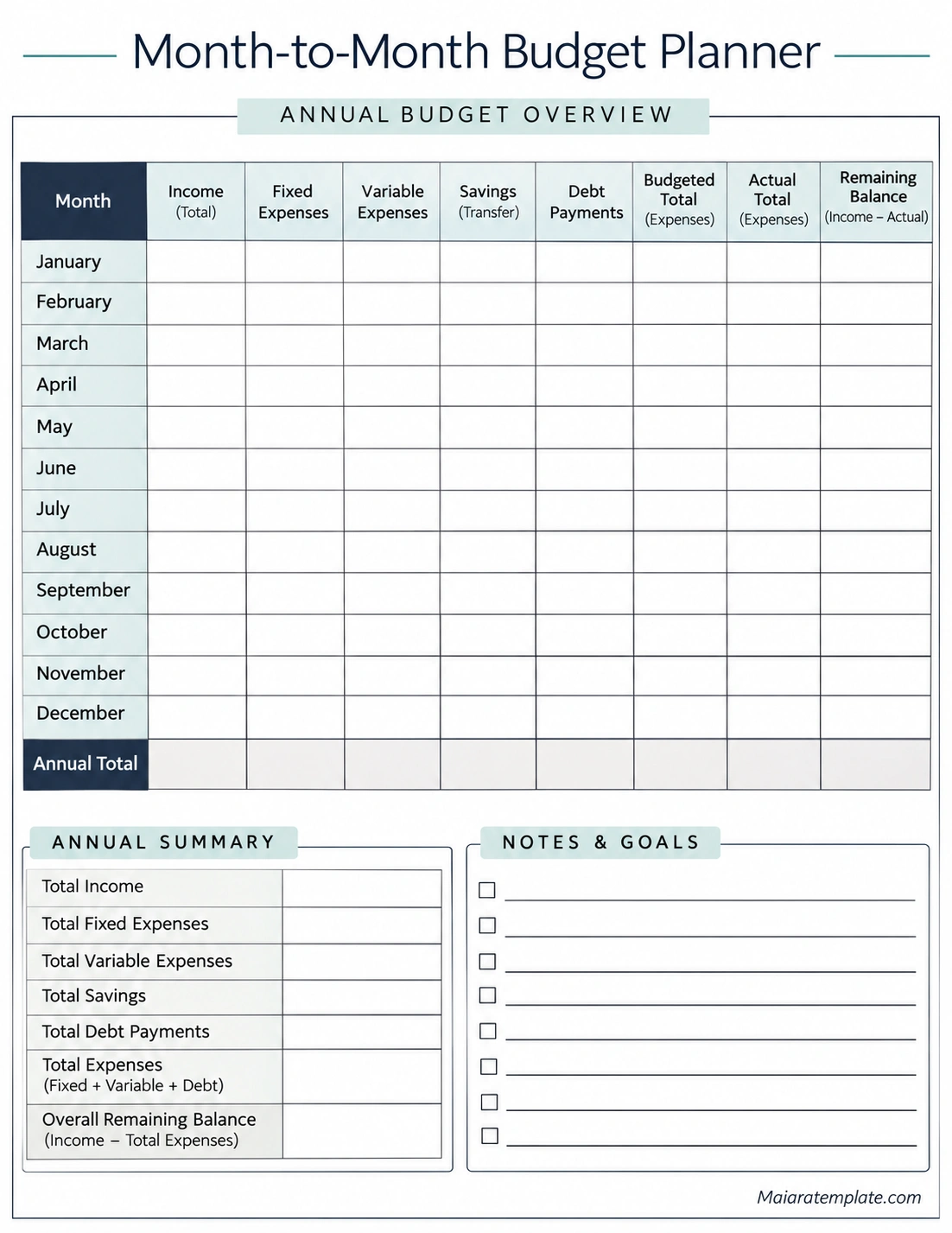
Use the monthly rows to record your financial activity throughout the year. At the end of each month, review the figures and update your annual summary. This gives you a convenient way to understand your progress without searching through separate worksheets.
How to Use a Month-to-Month Budget Planner
Using a budget planner does not have to be complicated. The key is to follow a consistent process and update your numbers regularly.
Step 1: Calculate Your Monthly Income
Begin by identifying your expected take-home income. Include reliable sources of earnings and calculate the total amount available for the month.
If you receive irregular income, consider using your average earnings from previous months or a conservative estimate to create a realistic spending plan.
Step 2: List Your Essential Expenses
Write down your fixed expenses, including housing, utilities, insurance, transportation, and minimum debt payments. These obligations should be considered before allocating money to optional purchases.
Next, estimate your variable expenses using previous receipts, bank statements, or spending records.
Step 3: Set Your Monthly Savings Goals
Decide how much money you want to save during the month. Your goals might include building an emergency fund, preparing for a vacation, saving for a major purchase, or contributing to retirement.
Include savings as a planned budget category rather than waiting to see how much money remains at the end of the month.
Step 4: Record Your Actual Spending
Throughout the month, update your worksheet whenever you receive income or make a purchase. Recording transactions regularly helps you identify overspending before it becomes difficult to correct.
You can update your printable worksheet weekly or use a digital spreadsheet if you prefer automatic calculations.
Step 5: Review Your Monthly Balance
At the end of the month, calculate your remaining balance by subtracting your actual expenses from your total income.
A positive balance means you have money remaining after the expenses included in your calculation. A negative balance indicates that your spending exceeded your available income.
Use the results to decide what changes might improve your next month’s budget.
Use the 50/30/20 Budgeting Rule
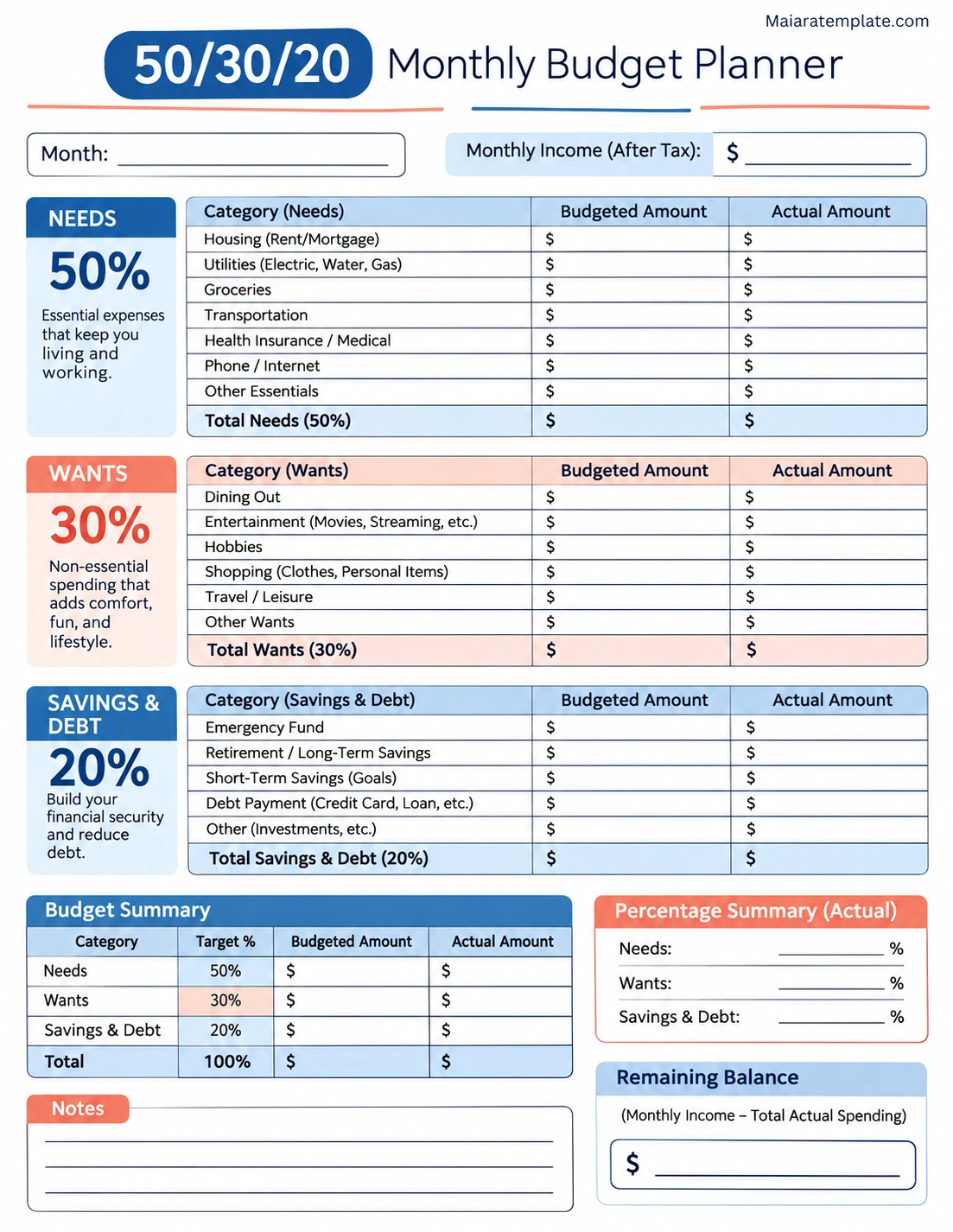
The 50/30/20 budgeting rule is a popular approach for dividing your monthly after-tax income into three main categories. It provides a simple starting point if you are unsure how much to allocate to different financial priorities.
- 50% for needs: Essential expenses such as housing, groceries, utilities, insurance, and transportation.
- 30% for wants: Nonessential spending such as dining out, entertainment, shopping, and hobbies.
- 20% for savings and debt: Emergency savings, investments, and additional debt repayments.
For example, if your monthly take-home income is $3,000, the suggested allocation would be:
- Needs: $1,500.
- Wants: $900.
- Savings and debt: $600.
These percentages are guidelines rather than strict requirements. If your housing costs are high or you have significant debt, adjust the allocations to reflect your current financial situation.
Track Monthly Income and Expenses More Effectively
One of the biggest benefits of a monthly income and expense tracker is that it helps you understand where your money goes. Rather than relying on memory, you can use actual spending records to make better financial decisions.
Try organizing your financial records into separate categories and reviewing them at least once a week.
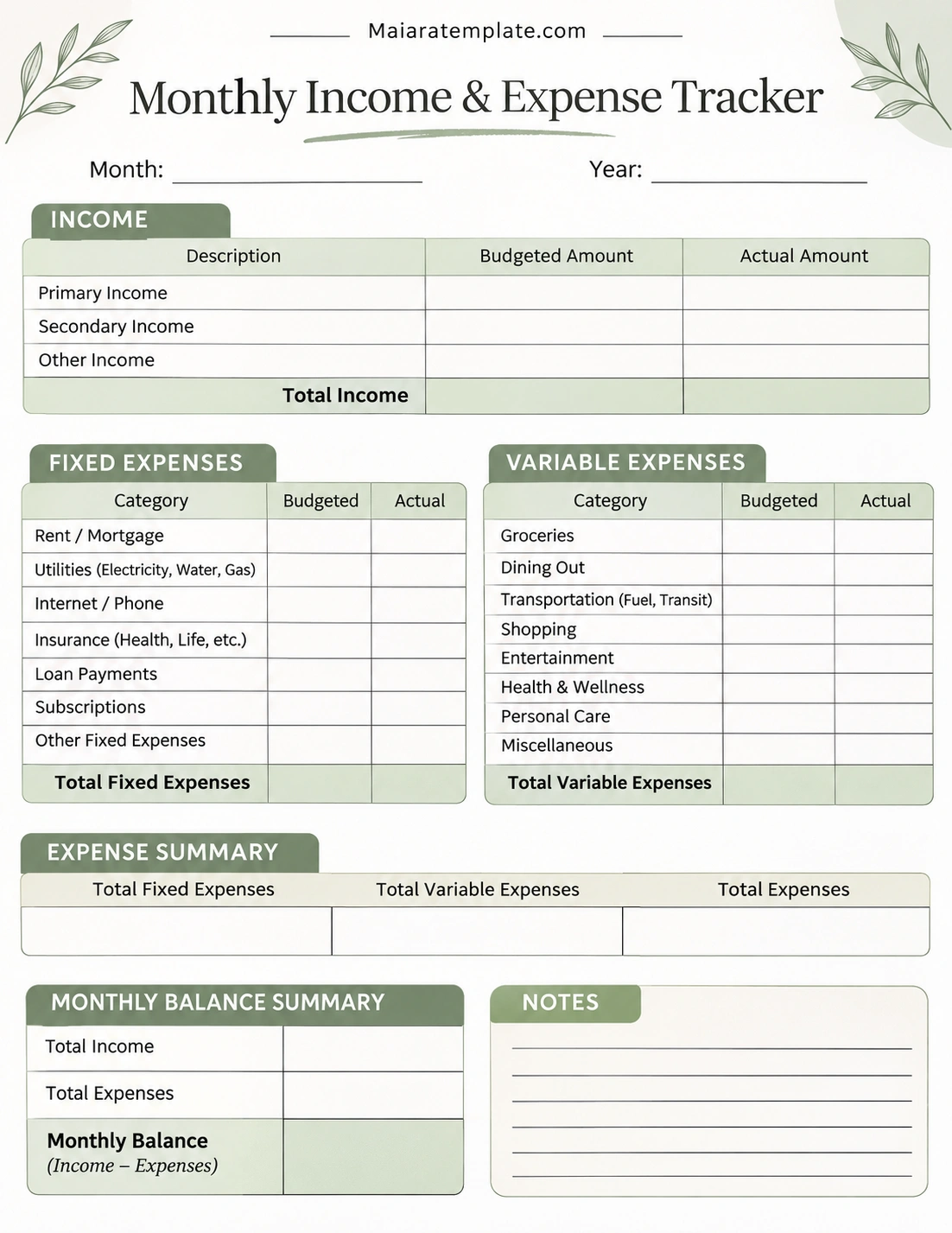
Here are a few practical habits that can make expense tracking easier:
- Keep receipts for purchases that are difficult to remember.
- Check recurring payments to avoid unexpected charges.
- Review grocery and transportation spending every week.
- Record irregular bills in advance.
- Compare actual expenses with your original budget.
Over time, these habits can reveal spending patterns and help you identify opportunities to save more money.
Plan Your Savings and Debt Repayment
Managing debt and building savings are two important parts of a healthy financial plan. A dedicated savings and debt tracker allows you to monitor both priorities without losing sight of your monthly spending limits.
Start by identifying your financial goals and assigning a target amount to each one. For debt, record the outstanding balance, minimum payment, and any additional amount you plan to pay.
For savings, track your starting balance, monthly contribution, and progress toward your target.
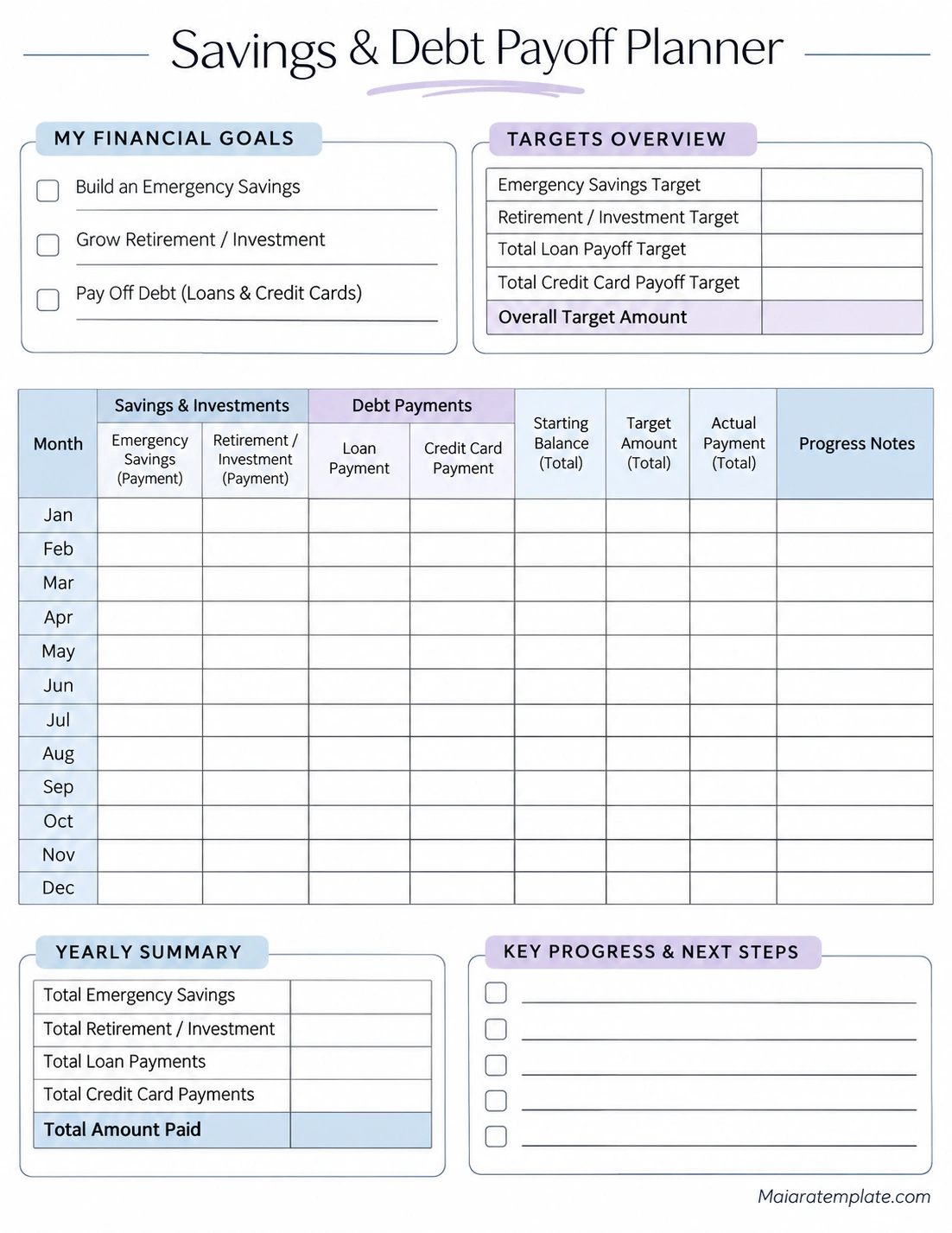
If you have multiple debts, consider prioritizing them based on interest rates or outstanding balances. Choose a repayment strategy that fits your financial situation and remain consistent with your payments.
Compare Your Budgeted and Actual Spending
Creating a monthly budget is only the first step. Reviewing your actual spending is what helps you understand whether your financial plan is working.
At the end of every month, compare your planned amounts with your actual transactions. Identify categories where you spent more than expected and consider whether the difference was caused by an unexpected expense or a spending habit that needs attention.
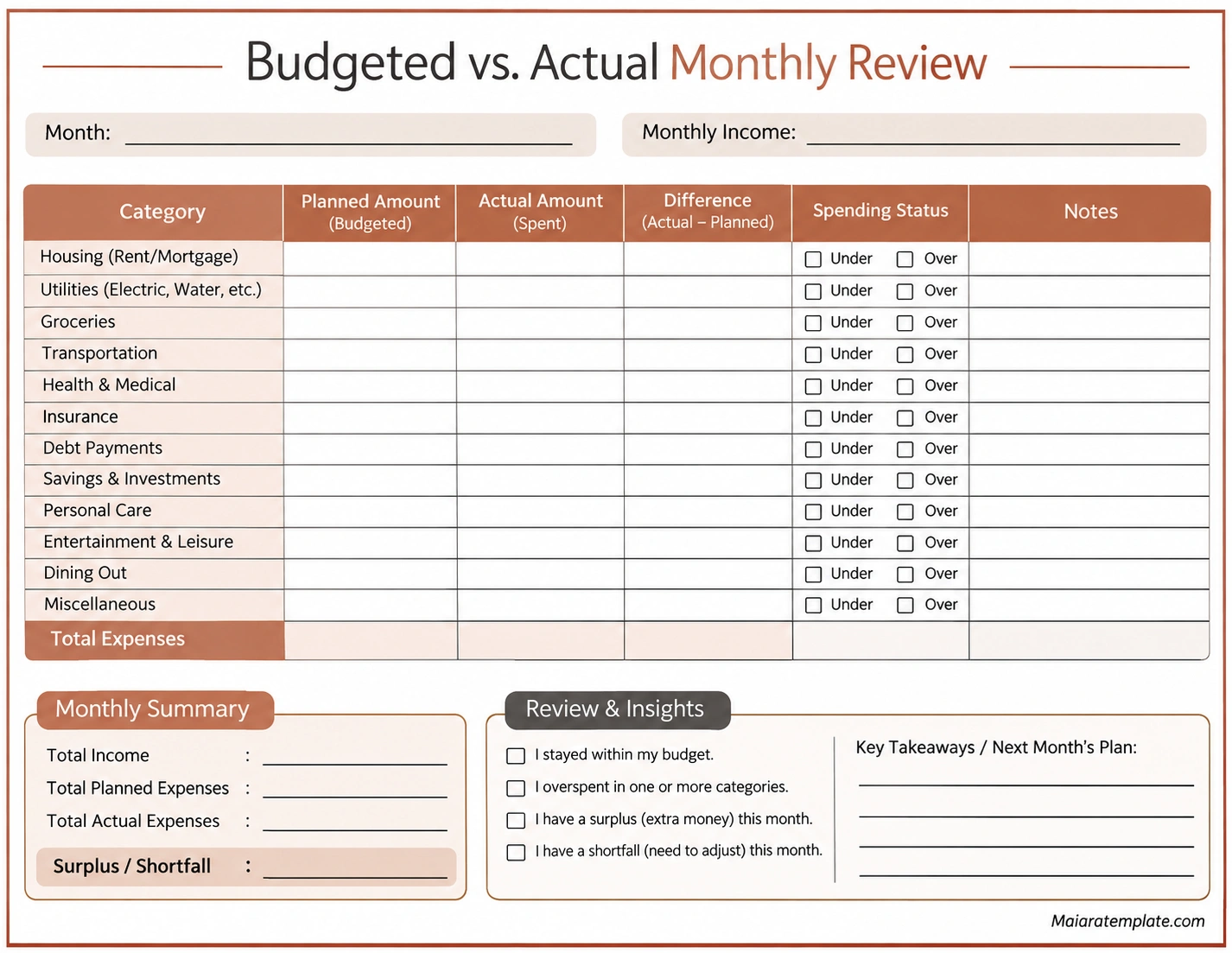
Use these questions during your monthly review:
- Did I stay within my planned spending limits?
- Which categories exceeded their budgets?
- Were there any unexpected expenses?
- Did I meet my monthly savings target?
- What changes should I make next month?
Even if your actual spending does not match your original plan perfectly, the review process can help you make gradual improvements.
Tips for Managing a Month-to-Month Budget Successfully
Consistency is more important than creating a perfect budget. A simple financial routine that you can maintain is usually more effective than a complicated system that you stop using after a few weeks.
Consider these practical budgeting tips:
- Be realistic: Set spending limits based on your actual income and living costs.
- Prepare for irregular expenses: Include annual insurance, vehicle maintenance, gifts, holidays, and other occasional costs.
- Review your budget weekly: Small adjustments are easier than correcting an entire month of overspending.
- Separate needs and wants: Understand which expenses are essential and which can be reduced.
- Prioritize emergency savings: Build a financial cushion for unexpected situations.
- Adjust when necessary: Update your budget when your income, expenses, or financial goals change.
- Celebrate progress: Recognize improvements in your savings habits and debt reduction.
Remember that your budget should support your lifestyle and financial priorities. It should provide direction without making everyday money management unnecessarily stressful.
Frequently Asked Questions About Month-to-Month Budget Planners
1. What is the purpose of a month-to-month budget planner?
A month-to-month budget planner helps you organize income, expenses, savings, and debt payments across the year. It allows you to monitor spending, compare planned and actual amounts, and make adjustments based on your financial progress.
2. What should a monthly budget worksheet include?
A monthly budget worksheet should include income sources, fixed expenses, variable expenses, savings contributions, debt payments, and a budgeted versus actual comparison. A remaining balance section is also useful for understanding your monthly cash flow.
3. How do I create a budget for every month?
Start by calculating your take-home income. List your fixed and variable expenses, set savings goals, and assign spending limits to each category. Record actual transactions throughout the month and review your results before preparing the next budget.
4. Is a monthly budget planner better than an annual budget?
Both serve different purposes. A monthly budget planner provides detailed information about your current spending, while an annual budget gives you a broader view of your financial goals and expenses throughout the year. Using both together can provide a more complete financial overview.
5. How often should I update my budget planner?
Ideally, update your budget whenever you receive income or make significant purchases. A weekly review is also helpful, while a more detailed evaluation should be completed at the end of each month.
6. Can I use a month-to-month budget planner with irregular income?
Yes. If your income changes frequently, estimate your monthly earnings conservatively using previous income records. Prioritize essential expenses and adjust discretionary spending based on the money you actually receive.
7. What is the 50/30/20 budgeting rule?
The 50/30/20 rule is a budgeting method that divides after-tax income into three categories: 50% for needs, 30% for wants, and 20% for savings and debt repayment. It provides a simple framework for organizing monthly finances.
8. Should I use a printable or digital monthly budget planner?
A printable budget planner is useful if you prefer handwriting financial information and keeping a physical record. A digital spreadsheet is convenient if you want automatic calculations, easy editing, and access across devices. Choose the format that makes it easiest for you to maintain a consistent budgeting routine.
Conclusion
A Month-to-Month Budget Planner is a practical tool for organizing your finances, controlling expenses, and working toward long-term financial goals. By tracking income, fixed and variable expenses, savings, and debt payments, you can understand your financial situation more clearly.
The most effective approach is to create a realistic monthly budget, record your actual spending, and review your results regularly. You can also use budgeting methods such as the 50/30/20 rule to establish a simple structure for allocating your income.
Whether you prefer a printable monthly budget worksheet or a digital spreadsheet, consistency is the key to making progress. Start with one month, review your results, and use what you learn to build a better financial plan for the months ahead.
Download: Month-to-Month Budget Planner Template
