A Short-Term Lease Agreement is a written rental contract designed for a temporary tenancy, usually lasting less than six months. It establishes clear terms between a landlord and tenant, including the rental period, rent amount, security deposit, property rules, utilities, maintenance responsibilities, and other important conditions. Having these details in writing can help both parties understand their rights and responsibilities before the tenancy begins.
Short-term rental arrangements can be useful for people who need temporary housing while relocating for work, completing a temporary assignment, traveling, renovating a home, or transitioning between permanent residences. For landlords, a short-term lease can provide greater flexibility when managing a property and adjusting rental arrangements based on demand. A well-prepared agreement gives both parties a clear framework for the entire rental period.
Whether you are a landlord preparing a temporary rental or a tenant reviewing an agreement before signing, understanding the essential elements of a short-term lease can make the process easier and more organized.
What Is a Short-Term Lease Agreement?
A Short-Term Lease Agreement is a legally binding rental document that defines the terms of a temporary rental arrangement. Unlike a traditional long-term lease, which often runs for one year or longer, a short-term lease typically covers a shorter and clearly defined period.
The exact definition of a short-term lease can vary depending on state and local laws. Some arrangements may last a few weeks, while others may extend for several months. The agreement should always state the exact start date and end date so there is no confusion about when the tenancy begins and ends.
A short-term lease is different from an informal rental arrangement because it creates a written record of the expectations agreed upon by both parties. This can be particularly important when questions arise about rent, property damage, deposits, utilities, guests, or the tenant’s move-out date.
When Should You Use a Short-Term Lease?
A temporary lease can be appropriate in many situations where a tenant needs housing without committing to a traditional long-term rental.
- Relocating to a new city for work
- Working on a temporary assignment
- Waiting for a permanent home to become available
- Renovating or repairing a primary residence
- Attending school or a temporary training program
- Providing temporary housing for a family member
- Staying in a property for a limited period
- Managing a rental property during periods of changing demand
Landlords should also consider whether local laws, homeowners association rules, zoning requirements, or other regulations place restrictions on short-term or temporary rentals. A rental arrangement should comply with all applicable requirements before the tenant moves in.
What Should a Short-Term Lease Agreement Include?
A good lease agreement should contain enough information to clearly explain the rental arrangement. Although requirements vary by jurisdiction, several sections are commonly included in a short-term residential lease.
1. Landlord and Tenant Information
Start by identifying everyone involved in the agreement. Include the landlord or property owner’s legal name and contact information, along with the name and contact information of each tenant who will occupy the property.
Accurate contact information makes it easier to communicate about rent, repairs, notices, emergencies, and other matters during the lease term.
2. Property Information
The agreement should clearly identify the rental property. Include the complete property address and, when applicable, the apartment, unit, suite, or room number.
A brief description of the premises can also help establish exactly which portion of the property is being rented. If the tenant has access to parking spaces, storage areas, appliances, or other facilities, those details can be documented as well.
3. Lease Term
The lease term is one of the most important parts of a short-term rental contract. Clearly state the date when the tenant may move in and the date when the tenancy ends.
For example, the agreement might specify that the rental begins on June 1 and ends on September 30. If there are conditions for extending or renewing the arrangement, those terms should be written into the agreement rather than left to verbal discussions.
A clearly defined rental period helps both parties plan for move-in, move-out, property inspections, and any future rental arrangements.
4. Rent and Payment Terms
The agreement should state the total rent and explain how and when it must be paid. Depending on the arrangement, rent may be due weekly, biweekly, monthly, or according to another schedule permitted by applicable law.
Include the following details when appropriate:
- Amount of rent
- Payment due date
- Accepted payment methods
- Where or how payments should be submitted
- Late payment terms
- Any applicable fees that are legally permitted
Clear payment terms reduce misunderstandings and give both parties a written reference throughout the rental period.
5. Security Deposit
If a security deposit is required, the lease should state the deposit amount and explain the conditions governing its use and return. The agreement can also identify the types of deductions that may be permitted, such as damage beyond ordinary wear and tear, subject to applicable law.
Landlords should follow the security deposit rules that apply in their state or local jurisdiction. Deposit limits, holding requirements, notice obligations, and return deadlines can vary significantly.
6. Utilities and Services
Short-term rentals sometimes include utilities that tenants would normally pay separately. The agreement should make it clear which utilities and services are included in the rent and which are the tenant’s responsibility.
- Electricity
- Water and sewer
- Gas
- Internet
- Trash collection
- Heating or cooling
- Other property-related services
Specifying these responsibilities in advance can prevent disagreements over unexpected bills.
7. Permitted Use of the Property
The lease should explain how the property may be used. For a residential rental, the agreement may specify that the premises are intended for residential purposes only.
Additional restrictions may address illegal activities, business use, smoking, pets, parties, subleasing, or other activities. Any restrictions should be consistent with applicable laws and clearly communicated before the agreement is signed.
8. Maintenance and Repairs
Define the responsibilities of both parties for maintaining the property. The landlord will generally have certain legal obligations concerning the condition and habitability of the rental property, while tenants are typically expected to keep the premises reasonably clean and report problems promptly.
The agreement can explain how tenants should submit maintenance requests and who should be contacted in an emergency. It can also address responsibility for damage caused by the tenant or the tenant’s guests when permitted by law.
9. Additional Rules and Conditions
Every property is different, so a short-term rental contract may need additional provisions. Depending on the property and local requirements, these may address guests, parking, pets, smoking, noise, shared spaces, keys, access, cleaning, or move-out procedures.
Keep these provisions specific and easy to understand. Clear language is generally more useful than vague statements that could be interpreted in different ways.
10. Signatures
The agreement should provide a signature section for the landlord and every tenant who is legally entering into the rental arrangement. Each party should have an opportunity to review the complete document before signing.
Consider providing each party with a complete copy of the signed agreement and any attachments or addenda that form part of the rental contract.
Benefits of Using a Short-Term Lease Agreement
A written agreement can provide practical benefits for both landlords and tenants.
Benefits for Landlords
- Clearly documents the rental terms
- Defines the expected move-in and move-out dates
- Explains rent and payment requirements
- Documents responsibilities for utilities and maintenance
- Creates a written record of agreed property rules
- Can make temporary rental arrangements easier to manage
Benefits for Tenants
- Provides a clear understanding of the rental period
- Documents the agreed rent amount
- Explains deposit requirements
- Clarifies which utilities are included
- Provides written information about property rules
- Offers greater certainty about the temporary housing arrangement
Short-Term Lease vs. Month-to-Month Rental
A short-term lease and a month-to-month rental are not necessarily the same type of arrangement. A short-term lease generally establishes a specific rental period with defined beginning and ending dates. A month-to-month tenancy typically continues from month to month until properly terminated according to the agreement and applicable law.
For example, a landlord and tenant could sign a three-month lease with a fixed end date. In another arrangement, they might establish a month-to-month tenancy that continues until either party provides the required notice.
The legal treatment of these arrangements can differ by jurisdiction. Before selecting a rental structure, both parties should understand the rules that apply to the specific property.
Tips for Creating a Short-Term Lease Agreement
A lease does not need to be complicated to be useful. The goal is to make important expectations clear and reduce uncertainty.
- Use specific dates: Avoid vague descriptions of the rental period.
- Write down payment terms: State the rent amount, due date, and payment method.
- Clarify utilities: Identify which services are included in the rent.
- Document property rules: Address important restrictions before the tenant moves in.
- Explain the security deposit: State the amount and applicable conditions.
- Record property condition: Consider completing a move-in inspection and documenting existing damage.
- Keep copies: Both landlord and tenant should retain a signed copy.
- Check local requirements: Make sure the agreement complies with applicable state and local laws.
Common Mistakes to Avoid
Even a short rental arrangement can create problems when important details are left undefined. One common mistake is relying on verbal promises instead of putting important terms in writing.
Another issue is failing to specify the exact end date. This can create confusion about whether the tenant is expected to move out, renew the agreement, or continue under another rental arrangement.
It is also important not to assume that a generic lease template automatically complies with every state or local requirement. Rental laws can differ based on location, property type, and the nature of the tenancy.
Before using a template, review it carefully and adapt the provisions to the actual rental situation. For complex arrangements or situations involving unusual legal requirements, consider obtaining advice from a qualified local attorney or housing professional.
How to Use a Short-Term Lease Agreement Template
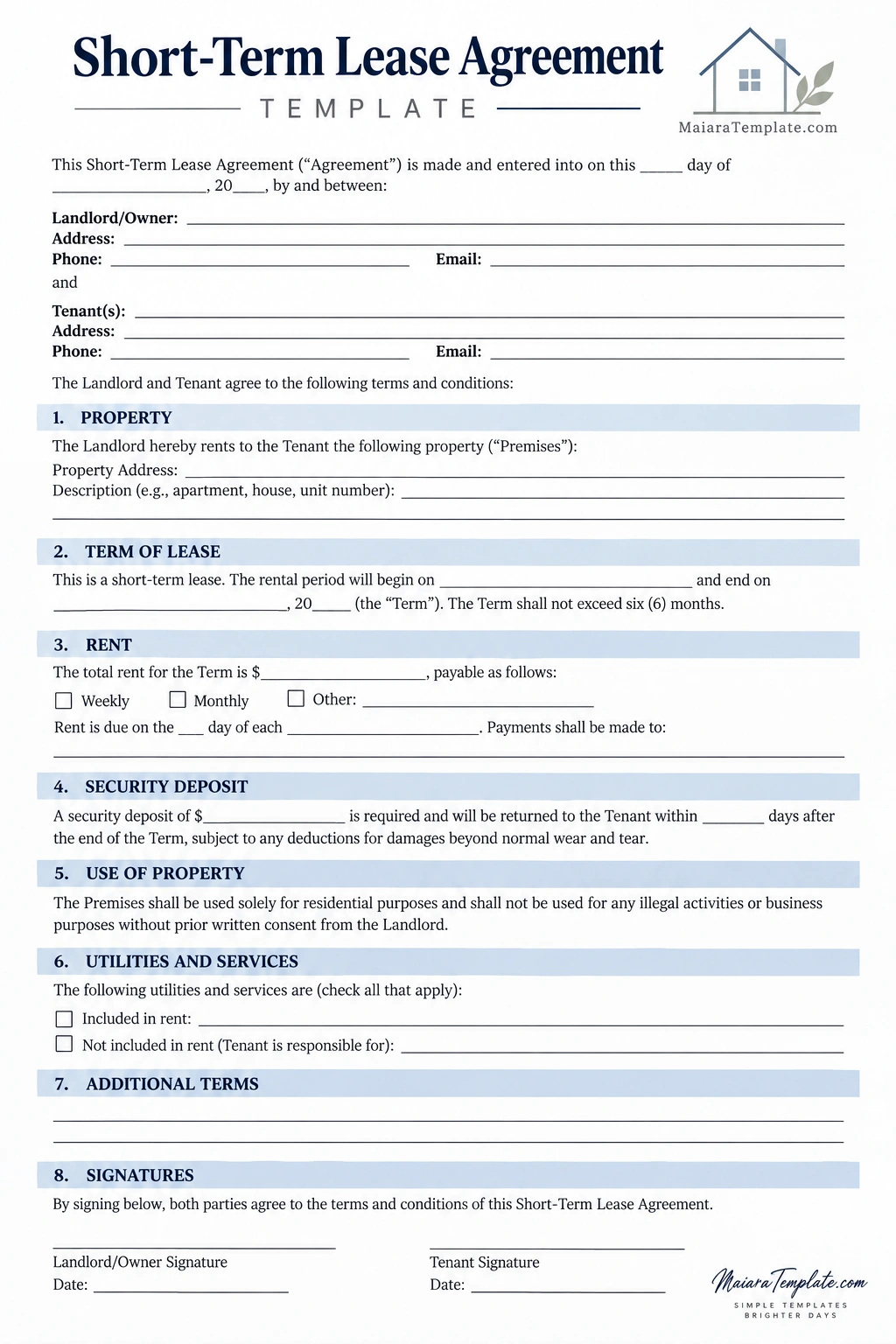
A Short-Term Lease Agreement Template can provide a convenient starting point for organizing a temporary rental arrangement. Instead of creating every section from scratch, landlords and tenants can use a structured document to identify the information that needs to be discussed.
Start by entering the landlord and tenant information, followed by the complete property address. Next, specify the lease start date, end date, rent amount, payment schedule, security deposit, and utility responsibilities.
Review the property rules and add any necessary conditions that apply to the specific rental. Both parties should carefully review the completed document before signing it.
A template should be treated as a general organizational tool rather than a substitute for legal advice. Local laws may require specific disclosures, notices, clauses, or procedures that are not included in a general template.
Final Thoughts
A Short-Term Lease Agreement provides a practical way to document a temporary rental arrangement and establish clear expectations between landlords and tenants. By specifying the rental period, rent, deposit, utilities, property rules, maintenance responsibilities, and other important terms, the agreement can help both parties approach the tenancy with a shared understanding.
Whether the rental lasts for a few weeks or several months, taking time to document the arrangement can make the rental process more organized. A well-structured template can make it easier to collect the necessary information, while reviewing applicable local laws helps ensure that the final agreement is appropriate for the property and tenancy.
For any rental arrangement involving unusual circumstances or significant legal concerns, the completed agreement should be reviewed by an appropriate legal professional before it is signed.
Short-Term Lease Agreement Template – Download

- Free Printable Time Log Template - September 17, 2026
- Free Printable Shipping Label Template - September 17, 2026
- Thank You Letter Template for a Job Offer - September 17, 2026
