An affidavit form is a written statement of facts that a person formally declares to be true under oath or affirmation. It is commonly used in legal matters, court proceedings, government applications, and administrative processes when written evidence is needed. By recording information in a structured document, an affidavit helps present facts clearly without requiring every detail to be delivered verbally at the beginning of a proceeding.
Whether you need to verify personal information, confirm an event, support a legal claim, or provide a statement for an official application, an affidavit form can help organize your information. However, the required format and signing procedure may vary depending on the jurisdiction and the purpose of the document. Understanding what to include and how to complete the form can help you prepare an accurate and useful statement.
What Is an Affidavit Form?
An affidavit form is a document used to record a person’s statement of facts under oath or affirmation. The person making the statement is known as the affiant or deponent. By signing the document under the required procedure, the affiant confirms that the information is truthful to the best of their knowledge and accepts the legal consequences of making a false statement.
In many situations, the affidavit must be signed in front of an authorized official, such as a notary public, commissioner of oaths, or another person legally permitted to administer an oath. The exact requirements depend on local law and the organization receiving the document.
Unlike an ordinary personal statement, an affidavit generally includes a formal declaration and an oath or affirmation section. It may also contain a signature block for the affiant and a jurat or certification completed by the authorized witness.
What Is an Affidavit Form Used For?
An affidavit can serve as written evidence or confirmation when an organization, court, or government agency requires a formal statement of facts. Common uses include the following.
- Court proceedings: Providing factual information to support a motion, application, or other legal matter when affidavits are permitted.
- Identity verification: Confirming personal details or explaining a discrepancy in official records.
- Lost document declarations: Explaining the circumstances surrounding a missing certificate, identification document, or other record when an affidavit is accepted.
- Immigration applications: Supporting certain applications with statements about relationships, residence, financial support, or other relevant facts, where permitted.
- Family matters: Recording information related to family relationships, caregiving, or other proceedings that accept sworn statements.
- Business and administrative matters: Confirming transactions, ownership details, or other facts requested by an institution.
- Estate matters: Providing information relevant to inheritance or estate administration when required.
Not every situation requires an affidavit. Some agencies have their own declaration forms, while others require specific wording or supporting documents. Always confirm the recipient’s requirements before preparing or signing the statement.
Printable Affidavit Form Template
A printable affidavit form provides a structured layout for entering personal information, describing relevant facts, and completing the required signature and witnessing sections. A general template can be a useful starting point when the receiving organization does not provide a mandatory form.
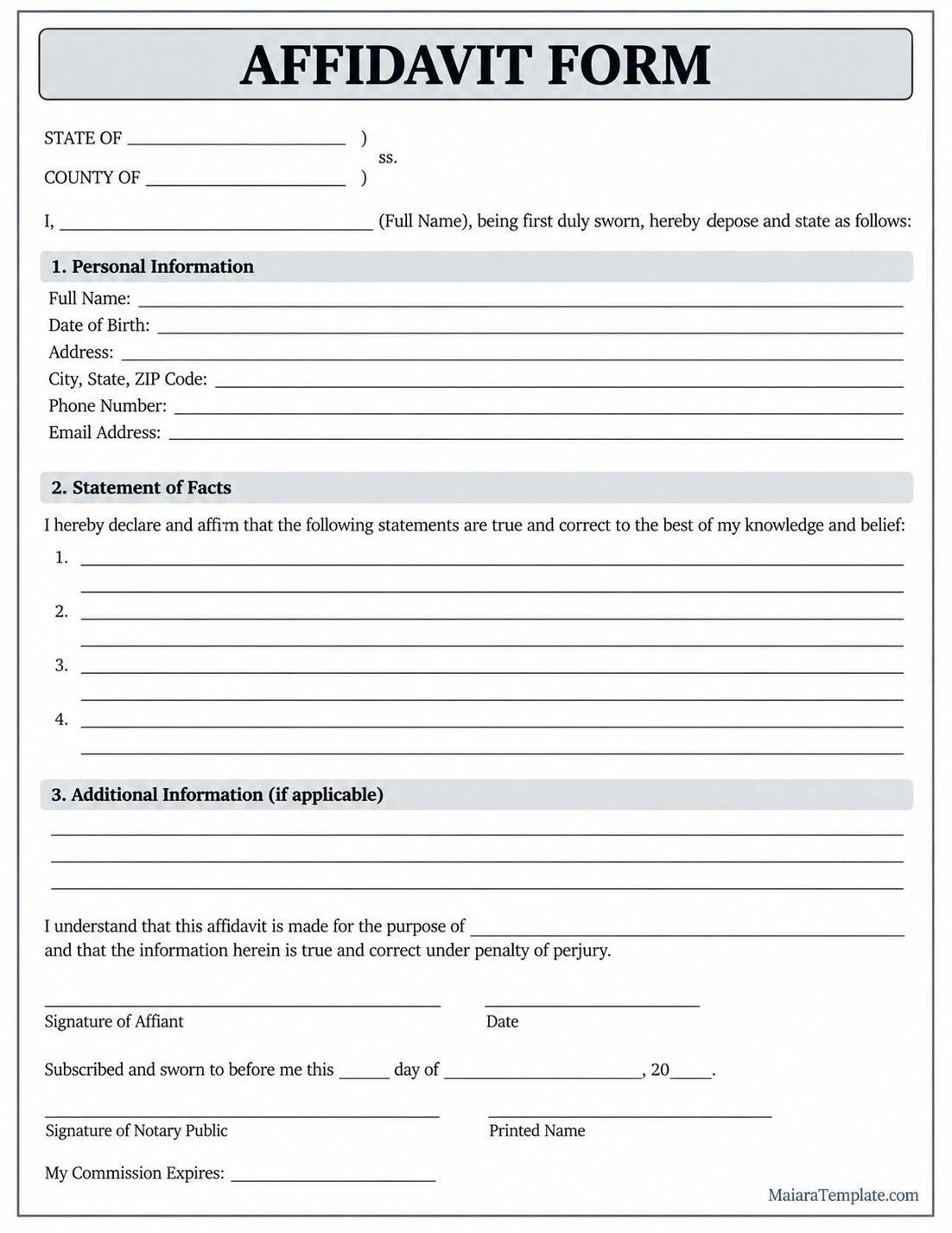
The template includes space for the jurisdiction, the affiant’s personal information, numbered statements of fact, additional details, a signature, and a notary section. These elements help organize a statement, but the template may need to be adjusted to meet the requirements of a particular court, agency, or jurisdiction.
What Should an Affidavit Form Include?
A complete affidavit typically contains several essential elements. The exact wording and layout may differ according to the type of affidavit and the applicable legal requirements.
Jurisdiction and Case Information
Some affidavits begin with the state, county, court, or other jurisdiction where the statement is being made. If the affidavit relates to an existing case or official application, it may also need a case number, reference number, or the names of the relevant parties.
Affiant’s Personal Information
The form should identify the person making the statement. Depending on the requirements, this section may include the affiant’s full legal name, address, and other identifying details. Include only information that is required or appropriate for the intended purpose.
Statement of Facts
This is the central part of the affidavit. It contains the facts the affiant is formally declaring to be true. Numbered paragraphs are often useful because they make each statement easier to identify, review, and reference.
Statements should be specific, clear, and factual. When a fact is based on information received from someone else rather than personal knowledge, the source may need to be identified. Whether such information is acceptable depends on the applicable rules.
Declaration Under Oath or Affirmation
The affidavit generally includes wording confirming that the statements are true and that the affiant understands the legal significance of the declaration. The required wording may vary by jurisdiction. Avoid changing prescribed language without checking whether the receiving authority permits it.
Signature and Date
The affiant’s signature and the date of signing are important parts of the document. If an oath or affirmation must be administered in person or through an approved remote procedure, do not sign the affidavit before the authorized official instructs you to do so.
Notary or Authorized Witness Section
When witnessing is required, the official completes the appropriate certification. This section may include the date, the official’s signature, printed name, title, seal, or commission information. The exact requirements depend on the official’s authority and the applicable law.
How to Fill Out an Affidavit Form
Completing an affidavit form carefully helps reduce errors and makes the statement easier for the recipient to review. Follow these steps as a general guide.
- Step 1: Confirm the required format. Ask the court, agency, or organization whether it provides an official affidavit form or requires specific wording.
- Step 2: Identify the affiant. Enter the requested personal details accurately and consistently with relevant official records.
- Step 3: Write the facts clearly. Describe the events, dates, people, and circumstances that matter to the purpose of the affidavit. Use numbered paragraphs when helpful.
- Step 4: Review the statement. Check names, dates, addresses, reference numbers, and supporting details. Remove speculation and statements that cannot be supported.
- Step 5: Prepare supporting documents. Attach records or exhibits if they are required or useful. Label attachments clearly and follow any applicable filing rules.
- Step 6: Arrange the oath or affirmation. If required, contact a notary public or another authorized official and confirm identification, appointment, fee, and witnessing requirements.
- Step 7: Sign according to instructions. Sign and date the document at the appropriate time, following the official’s directions.
- Step 8: Keep a copy. Retain a complete copy of the signed affidavit and its attachments for your records.
Tips for Writing a Clear and Effective Affidavit
The usefulness of an affidavit depends largely on the accuracy and clarity of the information it contains. These practical tips can help you prepare a more reliable statement.
- Stick to relevant facts. Include information that directly relates to the purpose of the affidavit rather than unrelated background details.
- Use precise language. Replace vague expressions such as “a long time ago” with a specific date or an approximate time frame when known.
- Separate facts from opinions. Clearly distinguish what you personally observed from assumptions, interpretations, or information provided by others.
- Organize events chronologically. A logical sequence can help readers understand what happened and when.
- Avoid exaggeration. Do not add details merely to make a claim appear stronger.
- Check names and dates. Small errors can create confusion or require corrections.
- Use the required format. Follow any rules about page numbering, attachments, exhibits, margins, or prescribed declarations.
- Understand the declaration. Read the completed affidavit carefully before swearing or affirming that its contents are true.
Common Mistakes to Avoid When Using an Affidavit Form
Even a well-designed affidavit template can be completed incorrectly. Pay particular attention to these common mistakes.
- Signing too early: Signing before meeting the authorized witness may invalidate the intended witnessing procedure or require the document to be completed again.
- Using a generic form when a specific one is required: A court or agency may reject a document that does not meet its prescribed format.
- Leaving required fields blank: Missing information can delay review. If a field does not apply, follow the recipient’s instructions rather than guessing what to enter.
- Including unsupported claims: A sworn statement should not contain invented facts or details presented as certain when they are not.
- Forgetting attachments: If the statement refers to supporting exhibits, confirm that the correct documents are attached and identified.
- Assuming notarization guarantees acceptance: Notarization or witnessing does not automatically make every statement admissible or satisfy every filing requirement.
- Ignoring local requirements: Rules for affidavits differ across jurisdictions and types of proceedings.
Affidavit Form vs. Declaration Form
An affidavit and a declaration can both be used to present facts in writing, but they may involve different formalities. An affidavit generally requires the person making the statement to swear an oath or affirm its truth before an authorized official. A declaration may be made under a legally recognized declaration of truth without the same witnessing process, depending on the law and context.
Some jurisdictions recognize unsworn declarations as alternatives to affidavits in particular circumstances, while others require a sworn document or a specific statutory form. The two terms should not be treated as interchangeable without checking the applicable rules.
Frequently Asked Questions About Affidavit Forms
Can I create my own affidavit form?
In some situations, you can prepare an affidavit using a general template. However, the receiving court, agency, or organization may require its own form or specific wording. Confirm the requirements before using a self-prepared document.
Does an affidavit form need to be notarized?
Many affidavits must be sworn or affirmed before a notary public or another authorized official. Requirements vary by jurisdiction and purpose. Some declarations can be completed under different procedures, so check the rules that apply to your document.
Can I sign an affidavit electronically?
Electronic signatures and remote notarization are permitted in some jurisdictions and circumstances but not in all. Before signing electronically, verify that the receiving authority accepts the method and that all oath, identity verification, and witnessing requirements are satisfied.
What happens if I provide false information in an affidavit?
Knowingly making a false statement in a sworn affidavit may lead to serious legal consequences, which can include penalties for perjury or other offenses where applicable. Always provide truthful information and correct errors before signing.
Can an affidavit be used as evidence in court?
An affidavit may be used as evidence in certain court proceedings, applications, or procedural matters. Whether it is accepted, and what weight it receives, depends on the relevant rules, the purpose of the statement, and the circumstances of the case.
What should I bring when signing an affidavit?
Depending on the procedure, you may need acceptable identification, the completed but unsigned affidavit, supporting documents, and any required fee. Contact the notary or authorized official in advance to confirm what is needed.
Can I change an affidavit after signing it?
Do not alter a signed or sworn affidavit without checking the correct procedure. Depending on the circumstances, you may need to prepare a corrected affidavit, make a new statement, or follow a formal process to amend the document.
Conclusion
An affidavit form provides a structured way to present facts in a written statement that may be used for legal or administrative purposes. By including the required personal details, a clear statement of facts, the appropriate declaration, and the necessary signature or witness certification, you can prepare a document that is easier to review and understand.
Use a printable affidavit form template as a starting point, not as a guarantee that the document meets every legal requirement. Before signing, verify the receiving authority’s instructions, make sure every statement is accurate, and follow the applicable oath, affirmation, and witnessing procedures. For complex or high-stakes matters, consider consulting a qualified legal professional.
Download: Affidavit Form

- Affirmative Action Plan Template - October 11, 2026
- Free Printable Affidavit Form Template - October 11, 2026
- Free Printable Address Label Template - October 11, 2026
