A Weekly Lesson Planner is a practical tool that helps teachers organize what students need to learn, how lessons will be taught, what resources will be used, and how learning will be assessed throughout the week. Instead of planning each class period without a broader view, teachers can use a weekly plan to connect individual lessons to larger learning objectives.
A well-organized lesson planner can make classroom preparation more manageable. It gives teachers a clear overview of upcoming topics, activities, materials, assessments, and important tasks. It can also make it easier to identify whether enough time has been allocated to each subject or learning objective.
Whether you teach elementary students, middle school students, high school students, or other learners, a weekly lesson plan can provide a flexible framework for organizing instruction. A printable weekly lesson planner is especially useful for teachers who prefer to write notes by hand and keep their plans readily available during the school week.
What Is a Weekly Lesson Planner?
A weekly lesson planner is a document used to organize classroom instruction across several days. It gives teachers a structured place to record what they intend to teach and how students will engage with the material.
Unlike a simple daily to-do list, a lesson planner connects teaching activities with learning objectives and assessment. This helps teachers think about the purpose of each lesson rather than simply listing classroom activities.
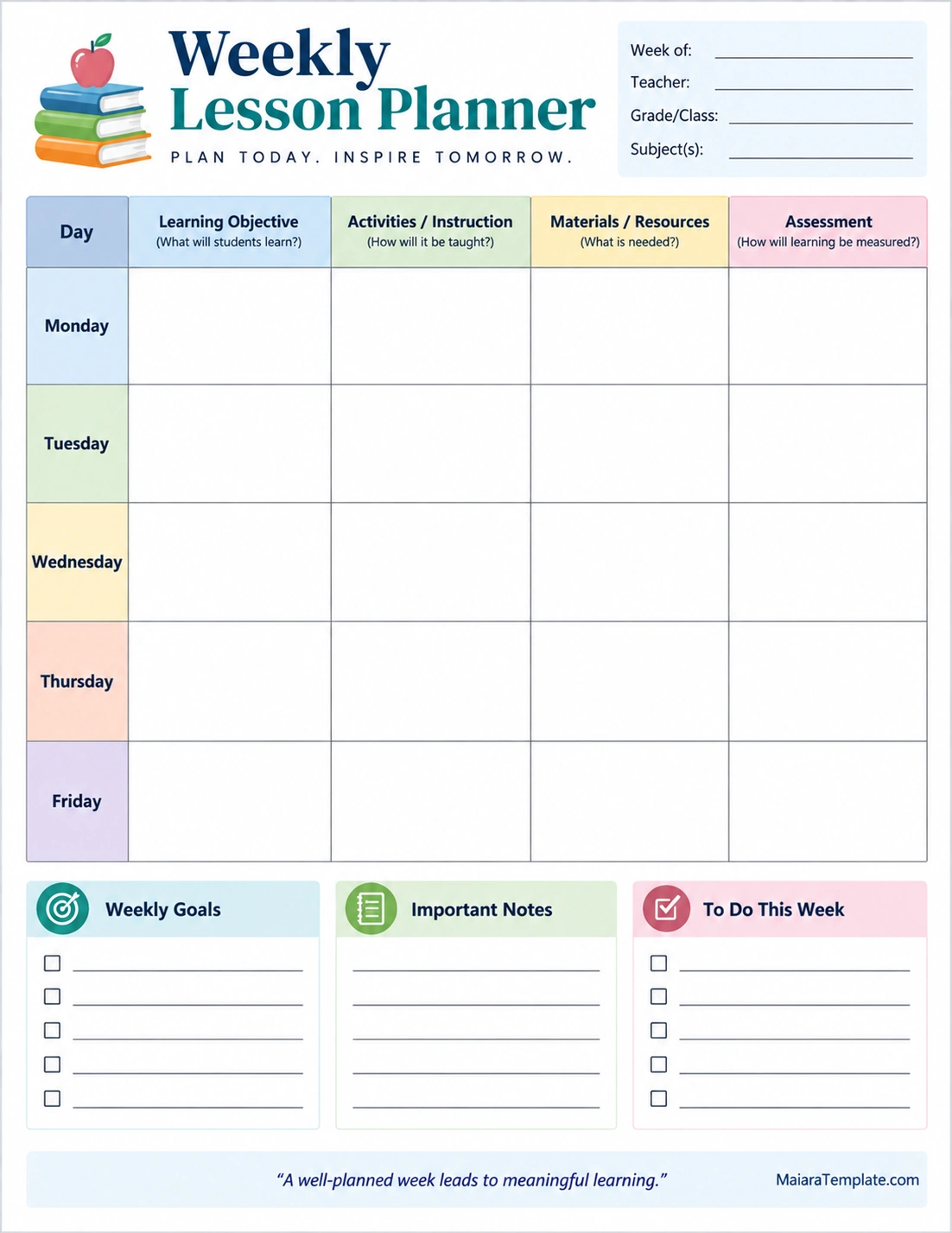
A typical weekly lesson planner may include:
- Week and teacher information
- Grade level or class
- Subject or subjects
- Daily learning objectives
- Teaching activities and instruction
- Materials and resources
- Assessment methods
- Weekly goals
- Important notes
- Teacher tasks and reminders
The format can be adapted to suit different teaching styles, grade levels, subjects, and school requirements.
Why Is a Weekly Lesson Planner Important?
Effective teaching requires more than knowing what topic comes next. Teachers also need to consider learning objectives, instructional methods, available resources, student understanding, and ways to measure progress. A weekly planner brings these elements together in one place.
Provides a Clear Teaching Structure
A weekly plan gives teachers a roadmap for the upcoming days. Instead of deciding everything immediately before class, teachers can prepare lessons in advance and understand how each day’s instruction fits into the broader week.
Helps Manage Classroom Time
Classroom time is limited. Planning lessons across the week makes it easier to estimate how much time should be devoted to instruction, practice, discussion, activities, and assessment.
Keeps Learning Objectives Visible
Learning objectives help teachers define what students should understand or be able to do. Including objectives in a weekly planner keeps those goals connected to classroom activities.
Supports Consistent Assessment
A lesson planner can include a space for assessment methods, allowing teachers to think ahead about how they will determine whether students have understood the material.
Reduces Last-Minute Preparation
Preparing a week’s lessons in advance can reduce the need to make every teaching decision immediately before class. Teachers can review the plan at the beginning of the week and make adjustments as needed.
What Should Be Included in a Weekly Lesson Plan?
The exact contents of a weekly lesson plan depend on the teacher and educational setting. However, several sections are useful for most classroom environments.
Learning Objectives
Learning objectives describe what students should learn during a lesson. A useful objective should be clear enough to guide instruction and assessment.
For example, instead of writing “fractions,” a teacher might identify a more specific objective related to comparing or solving problems involving fractions.
Activities and Instruction
This section explains how the teacher will help students reach the learning objective. It may include direct instruction, demonstrations, group activities, discussions, independent practice, projects, experiments, or other instructional strategies.
Materials and Resources
List the materials required for each lesson so they can be prepared ahead of time. Depending on the subject, this might include textbooks, worksheets, presentations, manipulatives, laboratory materials, reading materials, or digital resources.
Assessment
Assessment helps teachers determine whether students have understood the lesson. It can include quizzes, written assignments, questions, classroom discussions, projects, observations, exit tickets, or other appropriate methods.
Notes and Reminders
A notes section gives teachers space to record information that does not fit neatly into the daily lesson structure. This might include reminders about upcoming events, students who need additional support, materials to prepare, or lessons that may need adjustment.
How to Create a Weekly Lesson Planner
Creating a weekly lesson planner is easier when you start with the learning goals and then build the instructional activities around them.
Review the Curriculum
Begin by reviewing the curriculum, syllabus, standards, or course objectives relevant to the upcoming week. Identify the topics and skills that need to be addressed.
Set Weekly Learning Goals
Determine what students should know or be able to do by the end of the week. These goals provide direction for the individual lessons.
Break Goals Into Daily Objectives
Divide the broader weekly goals into smaller daily learning objectives. This makes it easier to create a logical progression from one lesson to the next.
Choose Instructional Activities
Select activities that support each objective. Consider a mixture of explanation, guided practice, independent work, collaboration, discussion, and hands-on learning when appropriate.
Plan Assessment Opportunities
Decide how you will check student understanding. Assessment does not always have to be a formal test. Short activities and informal observations can also provide useful information about student progress.
List Required Materials
Record the resources needed for each lesson. Preparing materials in advance can help the class run more smoothly.
Example of a Weekly Lesson Planning Structure
A five-day weekly lesson plan can provide a simple framework for organizing Monday through Friday.
Monday
Introduce the week’s main topic and establish the foundational knowledge students will need. Use an introductory activity, explanation, discussion, or diagnostic assessment to determine what students already understand.
Tuesday
Build on Monday’s lesson with additional instruction and guided practice. Students can apply the new concepts with teacher support.
Wednesday
Use the middle of the week to deepen understanding through practice, problem-solving, discussion, collaboration, or hands-on activities.
Thursday
Provide opportunities for students to apply what they have learned with greater independence. This can also be an appropriate time to identify areas that require additional instruction.
Friday
Review the week’s key concepts and assess student understanding. A short quiz, project, reflection, discussion, or other assessment can help determine progress toward the weekly goals.
This structure is only an example. Teachers should adjust the sequence according to the subject, curriculum, student needs, and available class time.
Benefits of Planning Lessons for the Entire Week
Planning one week at a time provides a useful balance between structure and flexibility. Teachers can see the larger instructional picture without committing every detail too far in advance.
- Creates a clear overview of upcoming lessons
- Helps connect daily lessons to weekly objectives
- Makes preparation more organized
- Supports better use of classroom time
- Makes required materials easier to prepare
- Provides opportunities for planned assessment
- Makes it easier to identify gaps in instruction
- Allows teachers to adjust lessons based on student progress
Weekly Lesson Planner for Different Grade Levels
A weekly lesson planner can be adapted for virtually any grade level. The amount of detail and type of activities will vary depending on the students.
Elementary School
Elementary teachers may need to organize several subjects throughout the week. A planner can help coordinate reading, writing, mathematics, science, social studies, art, and other activities.
Because younger students may require varied activities and transitions, including materials and instructional activities can be particularly useful.
Middle School
Middle school teachers may use separate weekly plans for different classes or subjects. The planner can help organize lessons around specific academic skills, projects, assessments, and assignments.
High School
High school lesson planning may involve more complex content, longer-term assignments, laboratory activities, projects, and formal assessments. A weekly overview can help teachers keep daily instruction connected to larger course objectives.
Weekly Lesson Planner for Different Teaching Styles
There is no requirement for every teacher to use exactly the same planning format. A good planner should support the teacher’s instructional approach rather than create unnecessary administrative work.
Traditional Classroom Instruction
Teachers who use a combination of direct instruction, guided practice, and independent assignments can use the planner to organize explanations, practice activities, resources, and assessments.
Project-Based Learning
For project-based instruction, the planner can focus on weekly milestones, student activities, resources, progress checks, and expected outcomes.
Blended or Digital Learning
Teachers using digital resources can include links or references to online materials in their planning system. A printable planner can still be used as a quick overview while detailed resources are maintained digitally.
How to Make a Weekly Lesson Plan More Effective
Keep Objectives Specific
Clear objectives make it easier to choose appropriate activities and assessments. Avoid objectives that are so broad that it is difficult to determine whether students have achieved them.
Plan for Flexibility
Even the best lesson plan may need to change. Students may need additional practice, a lesson may take longer than expected, or an unexpected school event may affect the schedule. Leave enough flexibility to make reasonable adjustments.
Balance Different Activities
Consider varying instructional activities throughout the week. Combining explanation, practice, collaboration, independent work, and assessment can provide different opportunities for students to engage with the material.
Prepare Materials Early
Review the materials column before the week begins. Preparing worksheets, books, presentations, equipment, or other resources ahead of time can reduce unnecessary interruptions during class.
Use Assessment to Guide the Next Lesson
Assessment should not simply mark the end of a lesson. Use information about student understanding to determine whether the next lesson should introduce new material, provide additional practice, or revisit a difficult concept.
Using a Printable Weekly Lesson Planner Template
A printable Weekly Lesson Planner Template can provide a convenient way to organize teaching plans on paper. A structured worksheet can include columns for each weekday and dedicated spaces for learning objectives, instructional activities, materials, and assessment.
Teachers can print a new copy each week and write their plans by hand. This approach can be useful for educators who prefer a physical planning system or want a quick reference to keep near their teaching materials.
A template can also be customized. Teachers may add subjects, class periods, homework reminders, student support notes, or other information that is relevant to their classroom.
Common Lesson Planning Mistakes to Avoid
Lesson planning becomes less effective when the plan is either too vague or unnecessarily complicated. Avoid these common problems:
- Writing objectives that are too broad
- Listing activities without connecting them to learning goals
- Planning too many activities for the available class time
- Forgetting to prepare required materials
- Leaving assessment until the last minute
- Creating a schedule with no room for unexpected changes
- Failing to adjust future lessons based on student understanding
- Making the planning process more complicated than necessary
How a Weekly Lesson Planner Supports Teacher Organization
Teaching involves many responsibilities beyond delivering lessons. Teachers may need to prepare materials, review student work, assess learning, communicate with families, manage classroom routines, and keep track of upcoming events.
A weekly planner provides one central place for the instructional portion of these responsibilities. By reviewing the plan at the beginning and end of the week, teachers can identify what has been completed and what needs to be adjusted.
The planner can also provide a useful record when preparing future lessons. Notes about activities that worked well or topics that required additional time can inform future planning.
Final Thoughts on Weekly Lesson Planners
A Weekly Lesson Planner helps teachers turn broad curriculum goals into an organized sequence of daily lessons. By recording learning objectives, instructional activities, materials, and assessment methods, teachers can create a clearer connection between what they teach and what students are expected to learn.
The most useful lesson plan is one that is practical and flexible. It should provide enough structure to guide instruction without making it difficult to respond to student needs or unexpected changes.
Whether you prefer a digital planning system or a printable weekly lesson planner, creating a clear weekly overview can make classroom preparation more organized. With consistent planning, teachers can spend less time figuring out what comes next and more time focusing on meaningful instruction and student learning.
Download: Weekly Lesson Planner Template

- Printable Weekly Cleaning Schedule Template - September 17, 2026
- Free Printable Travel Budget Template - September 17, 2026
- Printable Weekly Lesson Planner Template - September 17, 2026
