An apartment lease agreement is a written contract between a landlord and a tenant that explains the terms of renting an apartment. It establishes the rental period, monthly rent, payment deadlines, security deposit, maintenance responsibilities, and rules that apply during the tenancy. A clear agreement helps both parties understand their obligations before the tenant moves in.
Whether you are renting your first apartment, managing a rental property, or preparing a lease for a new tenant, documenting the arrangement can prevent misunderstandings and support a smoother rental experience. A well-organized apartment lease agreement also provides a written reference if questions arise about payments, repairs, property use, or ending the tenancy.
This guide explains what an apartment lease agreement should include, how to prepare one, which clauses deserve careful attention, and how to use a printable apartment rental agreement template. Because landlord-tenant laws vary by location, the final document should be reviewed for compliance with applicable local requirements.
What Is an Apartment Lease Agreement?
An apartment lease agreement is a legal contract that establishes the conditions under which a landlord rents a residential apartment to a tenant. It identifies the parties, describes the rental property, and sets out the rights and responsibilities associated with the tenancy.
The agreement typically specifies how long the tenant may occupy the apartment, how much rent is due, when payments must be made, and how maintenance issues will be handled. It may also address pets, parking, utilities, guests, subletting, property inspections, and procedures for ending the rental arrangement.
Although landlords sometimes use the terms lease and rental agreement interchangeably, a lease commonly refers to a fixed-term arrangement, while a rental agreement may refer to a periodic tenancy, such as a month-to-month arrangement. The legal distinction depends on the wording of the contract and the laws that apply.
Why Is an Apartment Lease Agreement Important?
A written apartment lease helps establish clear expectations before the tenancy begins. Both parties can review the terms, identify potential concerns, and confirm their understanding of the rental arrangement.
Protects Both Parties
A written contract documents the agreed rental terms and provides a reference if a disagreement develops. It can help clarify payment obligations, repair responsibilities, permitted uses of the apartment, and notice requirements. However, a lease cannot override applicable law or guarantee a particular legal outcome.
Clarifies Financial Obligations
The agreement should explain the rent amount, payment schedule, accepted payment methods, security deposit, and any other permitted charges. Clear financial terms reduce confusion about when payments are due and which costs are the responsibility of the landlord or tenant.
Establishes Property Rules
Rules concerning pets, smoking, parking, shared spaces, noise, and alterations can be documented in the lease or an appropriate addendum. Clear rules help tenants understand the conditions of occupancy and help landlords manage the property consistently.
Creates a Reference for Future Questions
During a tenancy, either party may need to confirm a move-out date, report a maintenance issue, or review the notice required for termination. Keeping a signed copy of the agreement makes it easier to locate the relevant terms.
What Should an Apartment Lease Agreement Include?
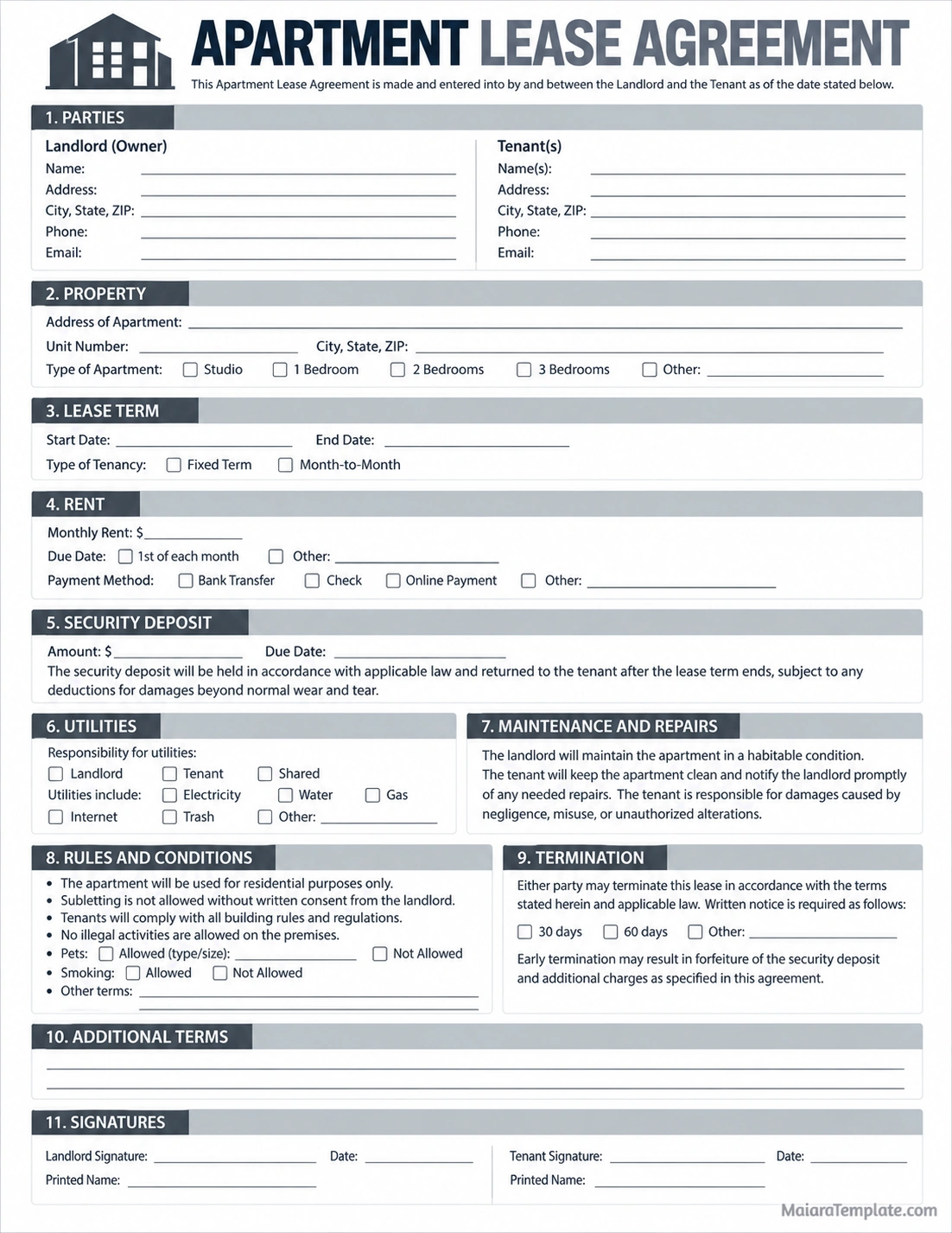
A complete apartment lease agreement should cover the essential details of the rental arrangement. The exact requirements vary by jurisdiction, so use the following sections as a planning checklist rather than a universal legal standard.
Landlord and Tenant Information
Identify the landlord or authorized property manager and every tenant who will be a party to the agreement. Include the appropriate legal names and contact details. If an agent manages the property, clarify how the agent should be contacted for rent payments, repairs, and official notices.
Apartment Description
Provide the full rental property address, including the apartment or unit number. If relevant, identify included storage areas, parking spaces, or other facilities. A precise description helps avoid confusion about which property and amenities are covered by the contract.
Lease Term and Move-In Date
State the tenancy start date and, for a fixed-term lease, the scheduled end date. Explain what happens when the initial term ends, including whether renewal requires a new agreement or whether another arrangement may apply under local law.
For a periodic tenancy, specify the rental period and the applicable procedures for giving notice. Do not assume that a standard notice period is valid in every location.
Rent Amount and Payment Terms
Clearly state the rent amount, due date, accepted payment methods, and the person or organization authorized to receive payments. If the agreement allows additional charges, describe their purpose and calculation method, subject to applicable law.
- Monthly rent amount
- Payment due date
- Accepted payment methods
- Payment recipient or payment instructions
- Applicable late-payment provisions, where legally permitted
- Rules governing changes to rent during or after the lease term
Security Deposit and Other Fees
If a security deposit is required, state its amount, when it must be paid, and how it will be handled. Explain the conditions for deductions and the process for returning the remaining balance, consistent with local law.
Any application fees, pet fees, parking charges, or other payments should be described clearly and assessed for legal compliance. Security deposit limits, permitted deductions, and return deadlines vary by jurisdiction.
Utilities and Maintenance Responsibilities
Explain which party is responsible for electricity, water, gas, internet, trash collection, and other services. The agreement should also describe how tenants report maintenance problems and how responsibility for repairs is allocated.
Landlords and tenants should understand their respective legal obligations concerning habitability, safety, ordinary upkeep, and damage. A contract should not attempt to transfer responsibilities in a way that violates applicable law.
Rules, Restrictions, and Additional Terms
Depending on the property, the lease may cover pets, smoking, guests, noise, parking, shared facilities, alterations, and subletting. Any restrictions should be written clearly and comply with applicable housing, disability, and other relevant laws.
If the property has community rules or a separate set of building regulations, identify the applicable document and explain how tenants can access it.
Signatures and Required Disclosures
Include signature and date fields for the landlord and tenants. Provide copies of any required disclosures, addenda, or notices. Depending on the location and property, specific disclosures may be required before or at the time the lease is signed.
How to Prepare an Apartment Lease Agreement
Preparing the agreement carefully can help both parties identify missing information before the tenancy begins.
Confirm the Property and Parties
Verify the property address, the landlord’s authority to rent the apartment, and the identities of all parties. Confirm which occupants will sign the agreement and which individuals, if any, are authorized to act on behalf of the landlord.
Agree on the Main Rental Terms
Confirm the rental period, monthly rent, payment date, deposit, utilities, and other financial responsibilities. Discuss property rules and maintenance procedures before including them in the final document.
Review Local Legal Requirements
Check applicable landlord-tenant laws concerning deposits, notices, rent changes, habitability, required disclosures, and termination. A generic apartment lease agreement template may omit provisions required in a particular city, state, or country.
Inspect and Document the Apartment’s Condition
Before move-in, consider completing a written property condition checklist. Record existing damage, appliance condition, keys provided, and other relevant details. Photographs can provide additional documentation when appropriate.
Attach the inspection record to the lease or keep it with the rental records. This can help both parties distinguish pre-existing conditions from damage reported later.
Review, Sign, and Distribute Copies
Read every clause before signing. Resolve unclear language, verify dates and amounts, and ensure all required attachments are included. Provide each party with a complete copy of the signed agreement and retain records securely.
Practical Tips for Landlords and Tenants
Good lease administration continues after the document has been signed. These practices can help prevent avoidable disputes.
- Use specific language. Replace vague phrases with clear dates, amounts, responsibilities, and procedures.
- Keep written records. Save payment confirmations, repair requests, inspection reports, notices, and signed amendments.
- Document the move-in condition. Record existing damage and the condition of included appliances and fixtures.
- Follow proper notice procedures. Use the delivery method and notice period required by the agreement and applicable law.
- Handle deposits lawfully. Follow local rules for holding, deducting from, and returning security deposits.
- Put changes in writing. Document agreed amendments and obtain the signatures or acknowledgments required for them to take effect.
- Respect privacy and access rules. Follow applicable requirements for landlord entry, inspections, and repairs.
- Review the lease before renewal. Confirm whether terms need to be updated and whether notices or disclosures are required.
Common Apartment Lease Agreement Mistakes to Avoid
Overlooking a small detail can create uncertainty during a tenancy. Review the agreement for these common problems before signing.
- Missing dates or property details. Incomplete information can make it difficult to identify the correct rental period or apartment.
- Unclear payment terms. State the rent amount, due date, payment method, and applicable charges precisely.
- Vague repair obligations. Explain how maintenance issues are reported while preserving each party’s legal responsibilities.
- Overly broad restrictions. Ensure rules concerning occupants, pets, accessibility, and property use comply with relevant law.
- Incorrect termination provisions. Do not assume that a standard notice period or automatic penalty is enforceable everywhere.
- Missing required disclosures. Check whether local law requires additional notices or documents.
- Failing to provide copies. Each party should retain the complete signed agreement and its attachments.
Frequently Asked Questions About Apartment Lease Agreements
Is an apartment lease agreement legally binding?
A properly formed apartment lease agreement is generally intended to be a legally binding contract. Its enforceability depends on the applicable law, the circumstances in which it was made, and the terms it contains. Certain clauses may be unenforceable if they conflict with legal protections.
What is the difference between a lease and a rental agreement?
A lease commonly establishes a fixed rental term, while a rental agreement often describes a periodic tenancy, such as month-to-month occupancy. However, terminology and legal effects vary by jurisdiction, so review the actual contract and local rules.
Can a landlord change the terms after signing?
A landlord generally cannot change every agreed term unilaterally during a fixed lease. The permitted process depends on the contract and applicable law. Some changes require mutual written agreement, while specific rules may govern rent adjustments or periodic tenancies.
What happens if a tenant breaks an apartment lease early?
The consequences depend on the lease, the reason for leaving, and local law. Potential outcomes may include notice obligations or financial liability, but legal exceptions and mitigation requirements can apply. Tenants should review the agreement and seek local advice before deciding how to proceed.
Is a written apartment lease required?
Requirements vary by jurisdiction and rental duration. Some arrangements may be recognized without a written contract, while certain leases must be written to be enforceable or to satisfy legal requirements. A written agreement is generally useful because it records the parties’ understanding.
Can I use a printable apartment lease agreement template?
Yes. A printable template can help organize the parties’ details, rent, lease term, deposit, maintenance provisions, and signatures. Customize it for the specific property and verify that it complies with applicable local requirements before use.
Should all tenants sign the lease?
Every person intended to be a tenant under the agreement should generally be identified and sign as required by the contract and applicable law. Occupants who are not tenants may have a different legal status, so clarify their roles rather than assuming everyone has identical responsibilities.
Conclusion
An apartment lease agreement establishes the essential terms of a rental arrangement, including the property, lease duration, rent, deposits, maintenance responsibilities, and rules for occupancy. Clear terms help landlords and tenants understand their obligations and provide a written reference throughout the tenancy.
Before signing, verify all names, dates, amounts, property details, and required disclosures. Use an apartment lease agreement template as a starting point, not a substitute for checking local housing laws. When the agreement involves unusual terms or significant legal questions, consider having it reviewed by a qualified local professional.
Download: Apartment Lease Agreement Template

- Apartment Lease Agreement Template - October 13, 2026
- Free Annual Report Template - October 13, 2026
- Free Annual Budget Template - October 13, 2026
