A Thank You Letter for a Job Offer is a professional message that allows you to express genuine appreciation after receiving an employment offer. It can also be used to confirm your decision, communicate your enthusiasm about joining the company, politely decline the position, or request additional time to consider the offer. A thoughtful response helps maintain a positive relationship with the employer regardless of the decision you ultimately make.
Receiving a job offer is an important milestone, but it is also a point where clear communication matters. Whether you accept, decline, or need more time to decide, your response should be timely, courteous, and professional. A well-written thank-you letter can acknowledge the employer’s time and confidence in you while giving you an opportunity to confirm important details about the position.
What Is a Thank You Letter for a Job Offer?
A Thank You Letter for a Job Offer is a formal or semi-formal letter sent to an employer after receiving an employment offer. Its purpose is to show appreciation for the opportunity and communicate your next step clearly.
The message can be relatively brief. You do not need to write a long letter simply to express gratitude. Instead, focus on being sincere, specific, and professional.
Depending on your circumstances, your letter may communicate one of three primary responses:
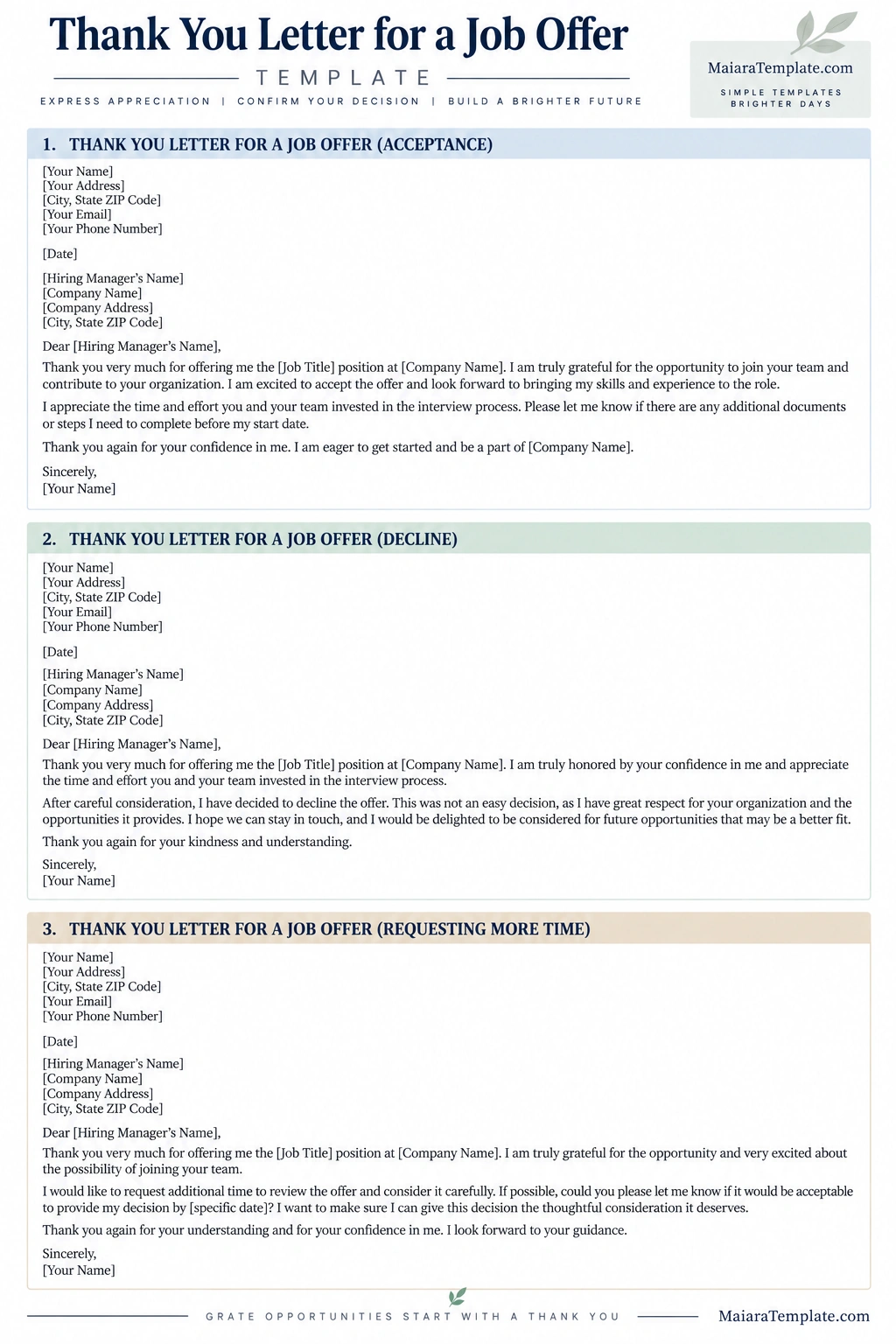
- Accepting the offer: Thank the employer and confirm that you are pleased to accept the position.
- Declining the offer: Express appreciation while respectfully explaining that you have decided not to accept.
- Requesting additional time: Thank the employer and politely ask for more time to review the offer before making a final decision.
Why Send a Thank You Letter After a Job Offer?
A job offer response is more than a simple courtesy. It provides a professional opportunity to acknowledge the employer and establish clear communication about what happens next.
Shows Appreciation
Hiring involves time and effort from recruiters, hiring managers, interviewers, and other employees. A thank-you message recognizes that effort and communicates your appreciation for being selected for consideration.
Confirms Your Decision
If you are accepting the position, your response can clearly communicate your decision and confirm that you understand the basic terms of the offer. If you are declining, a written response gives the employer a clear record of your decision.
Maintains a Professional Relationship
Career circumstances can change. You may encounter the same company, hiring manager, or professional contacts again in the future. Even when declining an offer, responding respectfully can help preserve a positive professional relationship.
Creates a Positive First Impression
Your communication after receiving an offer can reinforce the professional impression you established during the hiring process. A concise, thoughtful response demonstrates attention to communication and professional etiquette.
When Should You Send a Thank You Letter?
Ideally, send your response promptly after receiving the job offer. The appropriate timing depends on what the employer has requested and whether you need additional time to make your decision.
If you have already decided to accept, you can respond as soon as you have reviewed the offer and are prepared to confirm your acceptance. If you are declining, it is courteous to notify the employer promptly so the hiring process can continue.
If you need more time, do not simply delay your response. Thank the employer for the offer and ask whether you can have additional time to consider it. If the offer includes a specific deadline, acknowledge that deadline and request an extension before it passes.
What to Include in a Thank You Letter for a Job Offer
A professional job offer thank-you letter does not need to be complicated. Several basic elements can help you create a clear and complete message.
1. Professional Greeting
Address the person who sent the offer by name when possible. For example, you can use “Dear Ms. Johnson” or “Dear Mr. Smith.” If the communication has been informal and the employer has consistently used a first name, using that name may also be appropriate.
2. Expression of Gratitude
Begin by thanking the employer for the offer. Mention the position and company so that the purpose of your message is immediately clear.
Avoid overly generic statements. A simple and sincere expression of appreciation is usually more effective than excessive praise.
3. Your Decision
If you have decided to accept or decline, communicate the decision clearly. Avoid language that could leave the employer uncertain about whether you are accepting the position.
If you need additional time, explain that you would appreciate an opportunity to review the offer before making your final decision.
4. Relevant Next Steps
When accepting an offer, you can ask about onboarding instructions, required documents, the expected start date, or other practical next steps if they have not already been provided.
5. Professional Closing
End the letter with a professional closing such as “Sincerely,” “Best regards,” or another appropriate sign-off, followed by your name.
How to Write a Thank You Letter When Accepting a Job Offer
When you accept a job offer, your message should communicate appreciation, enthusiasm, and a clear acceptance. You can also use the opportunity to confirm important information that may need clarification.
Keep Your Acceptance Clear
Do not make the employer guess whether you are accepting. Use direct language such as “I am pleased to accept the position of [Job Title] at [Company Name].”
If the employer has already provided the salary, start date, work location, or other terms in the formal offer, you do not necessarily need to repeat every detail. However, confirming important information can be useful when appropriate.
Express Enthusiasm Professionally
Let the employer know that you appreciate the opportunity and are looking forward to joining the organization. Keep your enthusiasm genuine rather than excessive.
You might mention that you look forward to contributing to the team or using your skills in the new role.
How to Write a Thank You Letter When Declining a Job Offer
Declining an employment offer does not require a lengthy explanation. Your main objectives are to express appreciation, communicate your decision clearly, and maintain a respectful tone.
You can thank the hiring manager for the offer and for the time invested throughout the interview process. If appropriate, you may briefly state that you have decided to pursue another opportunity or take a different career direction.
You are not required to provide extensive personal details. A short, professional explanation is generally sufficient.
Keep the Door Open When Appropriate
If you genuinely want to maintain contact with the organization, you can express your interest in staying connected or being considered for future opportunities that may be a better fit.
Do not make promises you do not intend to keep. A sincere and respectful closing is enough to leave the relationship on professional terms.
How to Ask for More Time to Consider a Job Offer
Sometimes you need additional time before accepting or declining an offer. You may want to review the compensation package, compare opportunities, discuss the decision with your family, or consider whether the position meets your career goals.
In this situation, thank the employer for the offer first. Then clearly explain that you would appreciate additional time to review the details before providing your final decision.
If possible, propose a specific date when you can provide your answer. This makes the request easier for the employer to understand and demonstrates that you are taking the decision seriously.
Ask Rather Than Assume
Do not assume that you automatically have additional time beyond the deadline stated in the offer. Politely request an extension and allow the employer to determine whether it can accommodate your request.
Tips for Writing a Professional Job Offer Thank You Letter
A few simple practices can make your response more polished and effective.
- Respond promptly: Avoid unnecessary delays after receiving the offer.
- Be clear: Make your acceptance, decline, or request for more time easy to understand.
- Keep it concise: A thank-you letter usually does not need several pages.
- Use a professional tone: Write as you would communicate with a professional colleague.
- Personalize the message: Mention the specific position and company.
- Proofread carefully: Check names, job titles, company names, dates, and spelling.
- Confirm important details: If necessary, ask about start dates, paperwork, or onboarding instructions.
- Be sincere: Express genuine appreciation rather than using exaggerated language.
Common Mistakes to Avoid
Even a short professional letter can create confusion if it is poorly written. One common mistake is failing to communicate the decision clearly. If you are accepting an offer, explicitly state your acceptance. If you are declining it, say so respectfully.
Another mistake is providing unnecessary personal information. You generally do not need to explain every factor behind your decision. Keep the message focused on the professional relationship and the employment offer.
It is also important to avoid sending a generic message without checking the recipient’s name and company information. A small personalization can make the communication feel considerably more professional.
Finally, do not use an overly casual tone simply because the hiring process has been friendly. Match the communication style of the organization while maintaining professional standards.
Email or Printed Letter: Which Should You Use?
In many modern hiring situations, a thank-you response can be sent by email. Email is especially practical when the job offer itself was delivered electronically or when the employer expects a quick response.
A printed letter can be appropriate in more formal circumstances or when you want to provide a physical document. The most important factor is usually not the format but the clarity, timing, and professionalism of the message.
If the employer has specifically requested a particular communication method, follow those instructions.
Using a Thank You Letter for a Job Offer Template
A Thank You Letter for a Job Offer Template can simplify the writing process by providing a structured starting point. Instead of deciding how to organize every paragraph, you can focus on adapting the wording to your situation.
Begin by replacing placeholders with your name, contact information, hiring manager’s name, company name, position, and other relevant details. Then select the version that matches your situation: accepting the offer, declining it, or requesting additional time.
Read the completed letter carefully before sending it. Remove any statements that do not apply to your situation and make sure your final decision is communicated accurately.
Questions to Review Before Sending Your Letter
Before sending your job offer response, take a moment to review the message using a simple checklist.
- Did I address the correct person?
- Did I mention the correct job title?
- Did I spell the company name correctly?
- Did I clearly communicate my decision?
- Did I express genuine appreciation?
- Did I answer any requested questions?
- Did I include important questions that still need clarification?
- Did I check the offer deadline?
- Did I proofread the entire message?
This final review can help prevent small errors from creating unnecessary confusion during an important stage of the hiring process.
Final Thoughts
A Thank You Letter for a Job Offer is a simple but valuable piece of professional communication. Whether you accept the position, decline the offer, or request more time, your response should communicate appreciation and make your intentions clear.
The strongest letters are usually concise, specific, and sincere. Thank the employer for the opportunity, communicate your decision clearly, and address any necessary next steps. Even when you decide not to accept an offer, a thoughtful response can help maintain a respectful professional relationship.
Using a structured template can make the process easier, but always customize the final message to reflect your circumstances and communication style. Before sending it, verify the details and make sure the response accurately represents your decision.
Thank You Letter Template for a Job Offer – Download

- Free Printable Time Log Template - September 17, 2026
- Free Printable Shipping Label Template - September 17, 2026
- Thank You Letter Template for a Job Offer - September 17, 2026
