A startup business plan is a structured document that explains how a new business will operate, serve customers, generate revenue, and grow over time. It provides entrepreneurs with a practical roadmap for turning a business idea into an organized venture while helping them evaluate opportunities, identify risks, and establish clear priorities.
Creating a business plan is useful even when a startup is still in its early stages. The planning process encourages entrepreneurs to think carefully about their target market, products or services, competitors, marketing strategy, operations, financial needs, and long-term goals.
A well-organized startup business plan can also help communicate the business concept to potential investors, lenders, partners, employees, and other stakeholders. More importantly, it gives the founder a framework for making informed decisions as the business develops.
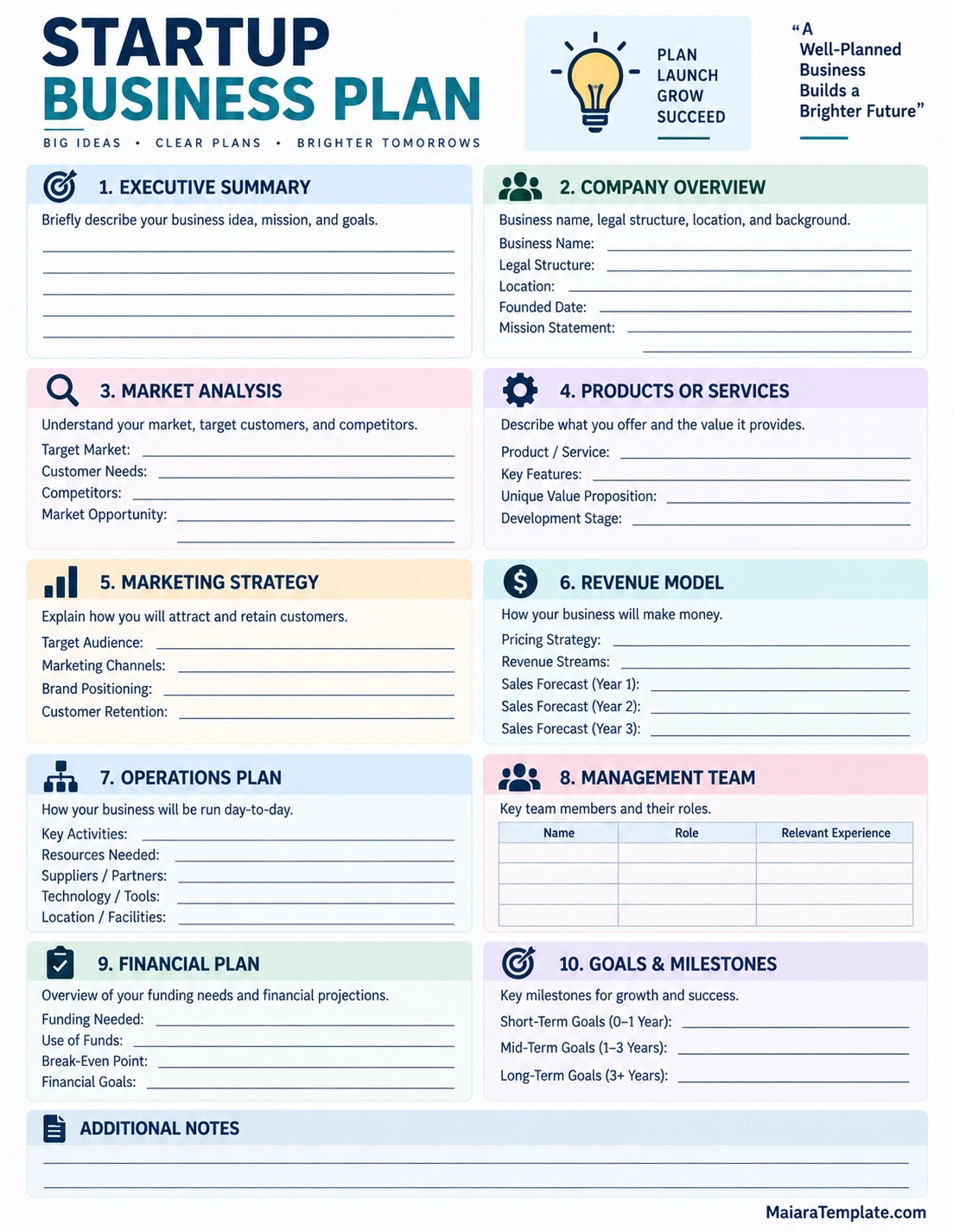
What Is a Startup Business Plan?
A startup business plan is a written framework that describes a new company’s business model, objectives, target customers, market opportunity, competitive environment, operating approach, and financial expectations.
Unlike a simple business idea, a business plan requires the entrepreneur to explain how the idea can become a functioning business. It connects the concept to specific actions, resources, customers, and financial considerations.
The plan can be relatively simple for a small startup or more detailed when it is being prepared for external funding or a complex business venture.
Why Is a Startup Business Plan Important?
Starting a business involves uncertainty. A business plan does not eliminate that uncertainty, but it provides a structured way to examine assumptions and identify areas that require further research.
- Clarifies the business idea and value proposition.
- Defines the target market and customer needs.
- Identifies competitors and market conditions.
- Establishes business goals and priorities.
- Explains how the company expects to generate revenue.
- Helps estimate startup costs and financial requirements.
- Provides direction for marketing and operations.
- Creates a framework for measuring progress.
- Can help communicate the business concept to potential partners or investors.
The planning process can also reveal weaknesses in an idea before significant time and resources are committed.
Key Sections of a Startup Business Plan
A startup business plan can be organized in several ways, but most useful plans address the major components of the business from strategy and customers to operations and finances.
Executive Summary
The executive summary provides a concise overview of the entire business plan. It should explain what the business does, who it serves, what problem it addresses, and what the startup aims to achieve.
Although the executive summary appears first, many entrepreneurs find it easier to write this section after completing the rest of the plan.
Company Overview
The company overview introduces the business. Include the proposed business name, legal structure, location, mission, business purpose, and background when applicable.
This section should give readers a clear understanding of what the company is and what it intends to accomplish.
Products or Services
Describe what the startup will sell or provide. Explain the main features, customer benefits, pricing approach, and the problem the product or service is designed to solve.
A strong description focuses not only on what the company offers but also on why customers would find the offering useful.
Market Analysis
The market analysis examines the environment in which the startup will compete. Research should cover the target audience, customer needs, market size, relevant trends, competitors, and potential opportunities.
This section helps entrepreneurs determine whether there is a meaningful market for the proposed product or service.
Marketing Strategy
The marketing strategy explains how the startup plans to attract potential customers and build awareness. Depending on the business, this may include search marketing, social media, content marketing, email, partnerships, advertising, events, or direct sales.
The plan should identify the intended audience and explain how the business will communicate its value to that audience.
Revenue Model
The revenue model explains how the startup expects to make money. Common approaches include product sales, subscriptions, service fees, licensing, commissions, memberships, and advertising.
Describe the primary revenue streams and explain how pricing relates to the value provided to customers.
Operations Plan
The operations plan explains how the business will function on a day-to-day basis. It can cover suppliers, technology, facilities, production, customer service, logistics, distribution, and other operational requirements.
A clear operations plan helps identify the resources needed to deliver the product or service consistently.
Management Team
Describe the founders, key team members, and their responsibilities. Highlight relevant experience, skills, and areas of responsibility that support the business model.
If important roles have not yet been filled, identify the capabilities the startup expects to need as it grows.
Financial Plan
The financial section provides an overview of the startup’s financial requirements and expectations. Depending on the purpose of the plan, it may include startup costs, operating expenses, pricing assumptions, revenue projections, cash flow estimates, and break-even considerations.
Financial assumptions should be based on reasonable research and clearly identified estimates rather than unsupported numbers.
Goals and Milestones
Define important milestones that indicate progress. These may include completing product development, launching a website, acquiring initial customers, reaching a revenue target, hiring key employees, or entering a new market.
Breaking long-term ambitions into measurable milestones makes the business plan more actionable.
How to Write a Startup Business Plan
Writing a business plan becomes easier when the process is divided into manageable steps. The following approach can help entrepreneurs move from an initial idea to a structured plan.
1. Define the Business Idea
Start by explaining the business concept in simple terms. Identify the problem you want to solve and the people who experience that problem.
2. Identify the Target Customer
Define the specific group of customers you intend to serve. Consider their needs, behaviors, preferences, location, purchasing habits, and other relevant characteristics.
3. Research the Market
Study competitors and market conditions before making major assumptions. Look for evidence about customer demand, pricing, competitors, market gaps, and potential challenges.
4. Define the Value Proposition
Explain why customers should choose your product or service. Your value proposition should connect the customer’s problem with the benefit your startup provides.
5. Develop the Business Model
Determine how the startup will create value and generate revenue. Consider pricing, sales channels, customer acquisition, operating costs, and the resources required to deliver the offering.
6. Create a Marketing Plan
Identify the channels and strategies you will use to reach potential customers. Set practical marketing objectives and determine how results will be measured.
7. Plan Operations
Document the processes, tools, suppliers, people, technology, and facilities needed to operate the business.
8. Prepare Financial Estimates
Estimate startup costs, ongoing expenses, expected revenue, and funding requirements. Use realistic assumptions and update them when better information becomes available.
9. Set Milestones
Convert broad goals into specific milestones. Assign target dates where appropriate and determine how progress will be measured.
10. Review and Update the Plan
A startup business plan should not be treated as a document that is written once and never changed. Customer feedback, market conditions, costs, competitors, and business priorities can change.
Review the plan regularly and update assumptions when new information becomes available.
Startup Business Plan Market Research
Market research is an important part of startup planning because a promising idea still needs a viable customer base. Research should focus on understanding the people who may purchase the product or service and the alternatives already available to them.
Useful research questions include:
- Who are the target customers?
- What problem are they trying to solve?
- How do they currently solve that problem?
- Who are the major competitors?
- What alternatives are available?
- What factors influence purchasing decisions?
- What price range may be acceptable to customers?
- Are there underserved customer segments?
Research can include customer interviews, surveys, competitor analysis, industry reports, public information, product testing, and other appropriate sources of evidence.
Startup Business Plan for Funding
Entrepreneurs may use a business plan when communicating with potential investors, lenders, grant programs, or other funding sources. In this situation, the plan should clearly explain the business opportunity, market, business model, use of funds, financial assumptions, and growth strategy.
Funding requirements should be specific. Rather than simply stating that the business needs capital, explain how the funds are expected to be used, such as product development, equipment, marketing, hiring, inventory, or operating expenses.
Different funding providers may have different requirements, so the business plan should be adapted to the intended audience.
Startup Business Plan and Risk Management
Planning can help entrepreneurs identify risks before they become expensive problems. Consider risks related to customer demand, competition, pricing, suppliers, technology, regulations, staffing, and cash flow.
For each significant risk, consider what could cause it, how it could affect the business, and what actions could reduce its potential impact.
This does not mean predicting every possible problem. The goal is to identify important assumptions and prepare reasonable responses to foreseeable challenges.
Common Startup Business Plan Mistakes
A business plan can lose its usefulness when it relies on vague statements or unrealistic assumptions. Avoiding common mistakes can make the document more practical.
- Being too vague: Clearly explain the customer, problem, solution, and business model.
- Ignoring competitors: Research existing alternatives rather than assuming there is no competition.
- Using unrealistic financial projections: Base estimates on reasonable assumptions and available evidence.
- Focusing only on the product: Explain how customers will discover, purchase, and use the offering.
- Ignoring operational requirements: Consider the people, tools, suppliers, technology, and processes needed to deliver the product or service.
- Never updating the plan: Revise assumptions as the startup learns more about its market and customers.
Tips for Creating a Practical Startup Business Plan
A useful business plan should be clear enough to guide action. Avoid filling the document with unnecessary information simply to make it longer.
- Use clear and specific language.
- Support important assumptions with research.
- Define measurable goals and milestones.
- Separate facts from estimates and assumptions.
- Focus on the needs of the target customer.
- Explain how the business will generate revenue.
- Identify major costs and resource requirements.
- Review potential risks and alternatives.
- Update the plan as the business develops.
Benefits of Using a Startup Business Plan Template
A startup business plan template provides a structured starting point for organizing the major components of a new business. Instead of deciding from scratch which topics to include, entrepreneurs can work through sections such as the executive summary, company overview, market analysis, products or services, marketing strategy, revenue model, operations, management, financial plan, and milestones.
A printable template can also be useful during brainstorming sessions. Entrepreneurs can write initial ideas by hand, compare assumptions, and refine the plan before preparing a more detailed business document.
The template should be treated as a planning tool rather than a substitute for market research or financial analysis.
Final Thoughts
A startup business plan provides a practical framework for turning a business idea into a structured plan of action. By examining the target market, customer needs, competitive environment, products or services, marketing strategy, revenue model, operations, team, finances, and milestones, entrepreneurs can better understand what is required to build and operate the business.
The value of a business plan comes from the thinking behind it, not simply from completing a document. A clear and regularly updated plan can help founders organize priorities, communicate their vision, identify important risks, and make better-informed decisions as the startup develops.
Download: Startup Business Plan Template

- Free Printable Travel Request Form Template - September 20, 2026
- Free Startup Business Plan Template - September 20, 2026
- Free Printable T-Chart Template - September 20, 2026
