A travel request form is a useful document for organizing and approving business travel before an employee leaves for a trip. It collects important information such as the traveler’s details, destination, purpose of travel, dates, estimated expenses, and required approvals in one place.
For organizations, a travel request form can make the travel approval process more consistent and easier to manage. It can also help employees understand travel requirements, provide managers with the information needed to approve trips, and create a record that can later support expense tracking, accounting, and auditing.
Whether a company has a formal corporate travel policy or a simple approval process, a well-designed travel request form provides a practical starting point for documenting business travel.
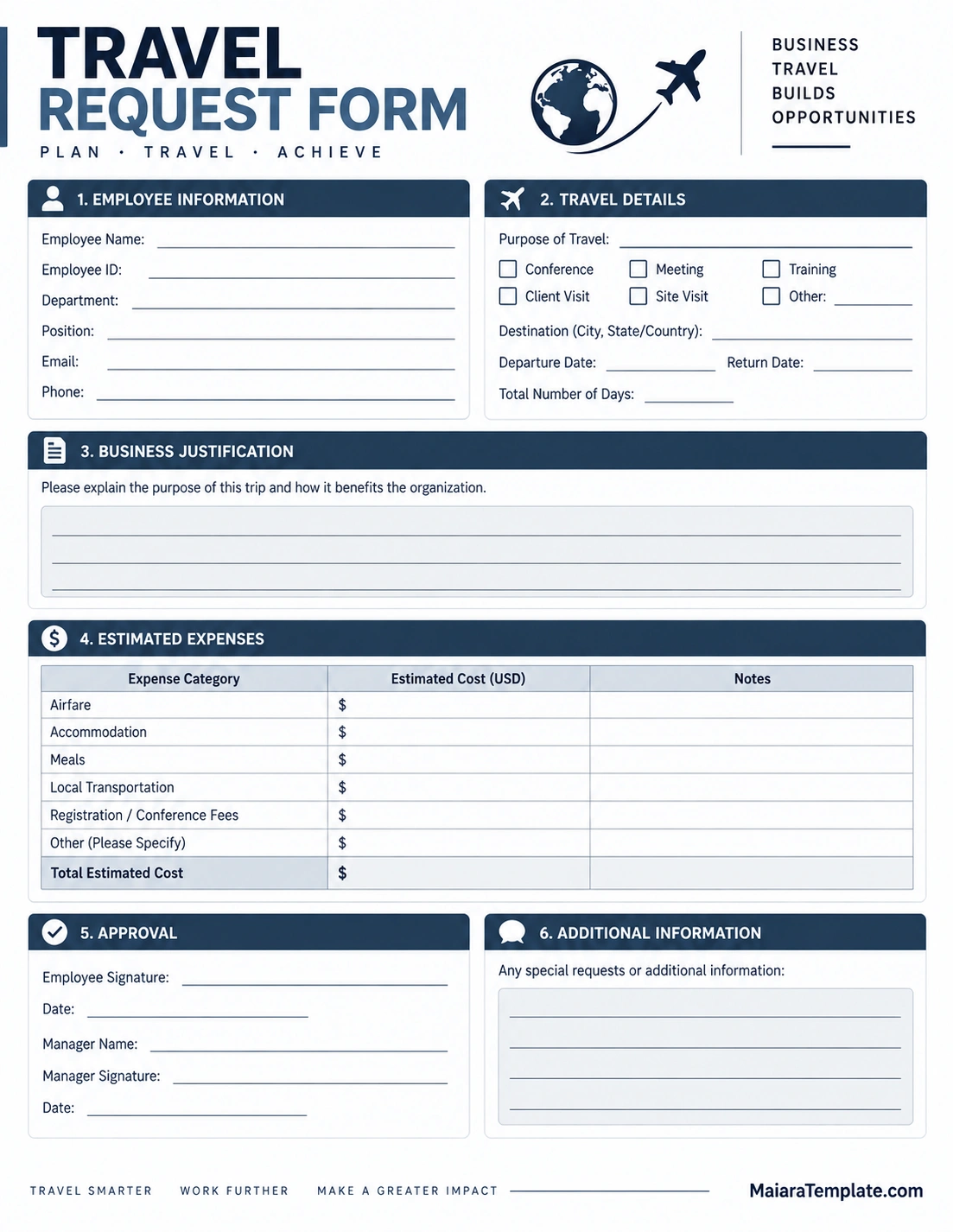
What Is a Travel Request Form?
A travel request form is a document employees use to request authorization for business-related travel. It is normally completed before a trip and submitted to a manager, supervisor, travel department, or other authorized person for review.
The form typically records information needed to evaluate the proposed trip. This may include the employee’s name, department, destination, travel dates, purpose of the trip, estimated costs, and approval details.
Depending on the organization, a travel request form may be completed on paper, as a fillable document, through an internal system, or using an online form.
Why Is a Travel Request Form Important?
Business travel can involve multiple costs and administrative requirements. A standardized travel request process helps an organization collect the necessary information before expenses are incurred.
A travel request form can help an organization:
- Document the purpose and details of business travel.
- Obtain approval before travel expenses are incurred.
- Estimate the expected cost of a trip.
- Compare proposed expenses with travel policies.
- Maintain consistent travel records.
- Support accounting and expense management.
- Improve communication between employees and managers.
- Provide documentation for internal reviews or audits.
For employees, the form also provides a clear checklist of information that needs to be considered before making travel arrangements.
What Information Should a Travel Request Form Include?
The exact information depends on the organization’s travel policy and approval process. However, a useful travel request form usually contains several core sections.
Employee Information
The first section should identify the person requesting travel. Common fields include the employee’s name, employee ID, department, position, email address, and phone number.
Accurate employee information makes it easier for managers, travel coordinators, and accounting staff to associate the request with the correct person.
Travel Details
The travel details section describes the proposed trip. It can include the destination, departure date, return date, number of travel days, and purpose of travel.
A form may also provide checkboxes for common business travel purposes such as conferences, meetings, training, client visits, or site visits.
Business Justification
The business justification explains why the trip is necessary and how it supports the organization’s objectives.
For example, an employee may need to visit a client, attend a professional conference, conduct training, inspect a facility, or participate in an important business meeting.
A concise explanation helps the approver understand the business purpose rather than evaluating the request based only on dates and estimated costs.
Estimated Travel Expenses
Travel costs can vary significantly depending on the destination and length of the trip. A travel request form should provide space for estimated expenses so that the organization can review the expected cost before approving the trip.
Common expense categories include:
- Airfare or other transportation.
- Hotel or accommodation.
- Meals.
- Local transportation.
- Conference or registration fees.
- Parking and other approved travel expenses.
- Other trip-specific costs.
Including a notes field next to each category can also help explain unusual or significant expenses.
Approval Information
The approval section documents who reviewed and authorized the request. Depending on company procedures, this may include the manager’s name, signature, approval date, or another authorization method.
Organizations with multiple approval levels can expand this section to include department heads, finance teams, travel coordinators, or other authorized reviewers.
Additional Information
An additional information section provides space for special requirements or details that do not fit into the standard fields.
This could include special travel arrangements, important scheduling information, conference details, client requirements, or other notes relevant to the trip.
How to Use a Travel Request Form
A travel request process should be simple enough for employees to follow consistently. The following steps provide a practical workflow.
1. Complete the Employee Information
Enter the requested employee details accurately. This establishes who is requesting the trip and which department or business unit is responsible for the travel.
2. Describe the Trip
Provide the destination, departure date, return date, number of days, and primary purpose of the trip. Be as specific as necessary to make the request easy to understand.
3. Explain the Business Purpose
Write a short explanation of why the travel is required. Focus on the business objective and the expected value of the trip.
4. Estimate the Expenses
List expected transportation, accommodation, meals, registration fees, and other relevant expenses. Estimates should be reasonable and based on available pricing information whenever possible.
5. Review Travel Policy Requirements
Before submitting the request, compare the proposed trip with the organization’s travel policy. Check requirements related to transportation, hotel limits, meal allowances, advance approval, and eligible expenses.
6. Submit the Request for Approval
Send the completed form to the appropriate manager or approval authority. Travel arrangements should generally follow the organization’s required approval process rather than being made without authorization.
7. Keep the Approved Request
Once approved, retain the request according to the organization’s recordkeeping procedures. The approved form can later be useful when reviewing travel expenses or reconciling the trip with accounting records.
Travel Request Form and Travel Policy
A travel request form works best when it supports the organization’s existing travel policy. The form itself should not replace the policy. Instead, it should help employees provide the information necessary to apply the policy consistently.
For example, a travel policy may specify preferred airlines, hotel limits, transportation rules, meal allowances, approval thresholds, or documentation requirements. The request form can collect estimated expenses and trip information that allow reviewers to check these requirements before approval.
Organizations should make the relationship between the form and the travel policy clear so employees know which rules apply to their trip.
Travel Request Form for Expense Management
One important benefit of a business travel request form is that it creates an estimate of expected expenses before the trip takes place. This provides a useful reference when actual expenses are submitted later.
For example, an employee may estimate $500 for airfare, $600 for accommodation, and $250 for meals and local transportation. After the trip, the actual expenses can be compared with the original request.
This comparison can help identify significant differences between planned and actual spending. However, estimated costs should not automatically be treated as final accounting amounts because actual expenses may change during the trip.
Travel Request Form for Accounting and Auditing
Business travel often generates several types of financial records. A properly completed travel request form can provide useful context for those records by documenting the reason for the trip, estimated costs, dates, and approval.
When combined with receipts, expense reports, invoices, and other supporting documentation, the approved travel request can help create a clearer record of the business trip.
For auditing purposes, organizations may use travel documentation to verify that expenses were associated with legitimate business activities and followed applicable internal procedures.
Travel Request Form vs. Expense Report
A travel request form and an expense report serve different purposes even though both relate to business travel.
- Travel request form: Used before or at the beginning of a trip to request approval and document expected travel details and costs.
- Expense report: Used after expenses have been incurred to document actual spending and request reimbursement or record expenses.
Some organizations may connect the two processes so the approved travel request can be referenced when the employee submits the final expense report.
Tips for Creating an Effective Travel Request Form
A good travel request form should collect enough information for an informed approval decision without becoming unnecessarily complicated.
- Keep the layout organized: Group related fields into logical sections.
- Use clear labels: Employees should understand what information belongs in each field.
- Include expense categories: Make common travel costs easy to estimate.
- Provide sufficient writing space: Business justification and special notes may require more than one line.
- Include approval fields: Clearly document who authorized the trip and when.
- Align the form with company policy: The information collected should support the organization’s travel requirements.
- Avoid unnecessary fields: Only request information that serves a useful administrative purpose.
- Make the form easy to review: Managers should be able to identify the destination, purpose, dates, and estimated cost quickly.
Benefits of a Printable Travel Request Form Template
A printable travel request form template gives organizations a consistent structure for documenting business travel. Instead of creating a new document for every trip, employees can use the same format for recurring travel requests.
A printable template can be especially useful for small businesses or departments that do not use a dedicated travel management system. It can be printed, completed by hand, reviewed by a manager, and retained with other administrative records.
Organizations can also customize the template by adding their logo, travel policy references, approval levels, expense limits, or additional fields that match their internal procedures.
Common Mistakes to Avoid
Small errors in a travel request can create unnecessary delays. Employees should review the form carefully before submitting it.
- Leaving important travel dates blank.
- Providing an unclear business purpose.
- Underestimating major travel expenses without explanation.
- Failing to check company travel requirements.
- Submitting the request too close to the departure date.
- Forgetting required approval signatures or authorization.
- Using inconsistent destination or traveler information.
A quick review before submission can help prevent avoidable corrections and approval delays.
Final Thoughts
A travel request form provides a simple and organized way to document proposed business travel before expenses are incurred. By recording employee information, travel details, business justification, estimated expenses, and approval information, the form can support a more consistent travel management process.
For organizations, the form can also create a useful record for expense management, accounting, policy compliance, and auditing. For employees, it provides a clear framework for preparing a complete travel request.
Whether used as a printed document or adapted into a digital workflow, a well-designed travel request form can make business travel planning more organized, transparent, and manageable.
Download: Travel Request Form Template

- Free Printable Travel Request Form Template - September 20, 2026
- Free Startup Business Plan Template - September 20, 2026
- Free Printable T-Chart Template - September 20, 2026
