An asset purchase agreement is an important document used when a buyer purchases specific assets from a business or individual seller. It sets out what is being sold, the purchase price, payment terms, closing arrangements, and the responsibilities of each party. By documenting these details, the agreement helps both sides understand the transaction and reduce the risk of disputes.
Asset purchase agreements are commonly used in business acquisitions involving equipment, inventory, intellectual property, vehicles, customer-related assets, or other specified property. Unlike a transaction in which a buyer purchases ownership interests in an entire company, an asset purchase allows the parties to identify which assets are included and which liabilities, if any, the buyer will assume.
In this guide, you will learn what an asset purchase agreement is, what clauses it commonly contains, how to prepare one, and how a printable asset purchase agreement template can help organize the terms of a transaction.
What Is an Asset Purchase Agreement?
An asset purchase agreement (APA) is a contract that records the terms under which a seller transfers specified assets to a buyer. The agreement identifies the parties, describes the assets, establishes the purchase price, and explains how and when the transaction will be completed.
Depending on the transaction, purchased assets may include machinery, office equipment, inventory, vehicles, trademarks, software, domain names, contracts, or other business property. The agreement may also include schedules listing individual assets and documents describing any excluded property or liabilities.
An asset purchase agreement can be used for a small business sale, the purchase of selected business operations, or a transaction involving particular assets rather than an entire company. The appropriate terms depend on the asset types, transaction structure, applicable law, and commercial risks involved.
Although an APA can specify that the buyer will not assume certain seller liabilities, that wording does not automatically eliminate every liability under applicable law. The parties should identify assumed and excluded obligations clearly and obtain legal advice when the transaction involves significant assets, employees, contracts, taxes, or regulated activities.
Free Printable Asset Purchase Agreement Template
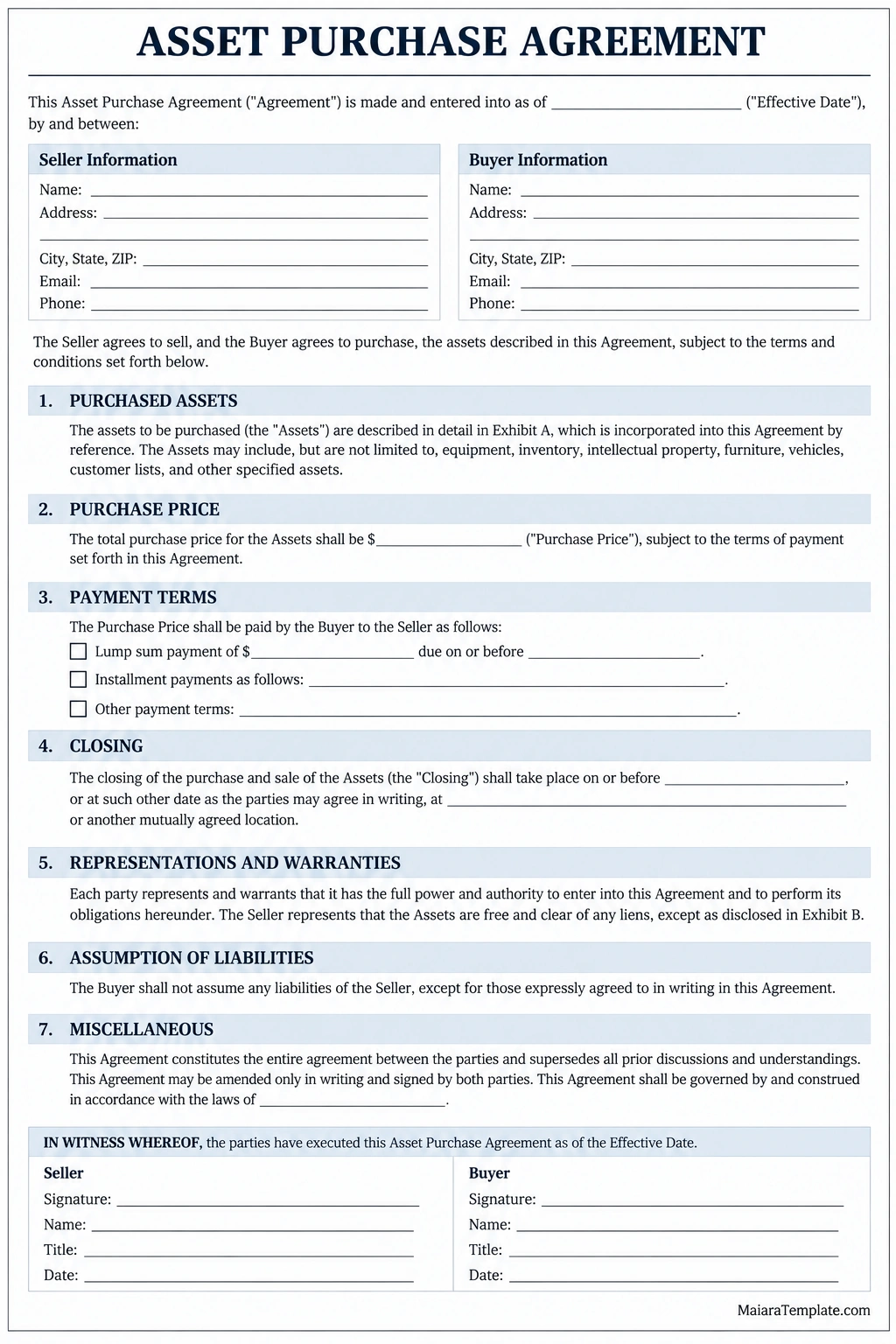
A printable asset purchase agreement template provides a structured starting point for documenting a transaction. It can help organize the seller’s and buyer’s information, the assets being transferred, the purchase price, payment terms, closing arrangements, warranties, liability provisions, and signature details.
The sample below uses a straightforward layout with numbered sections and spaces for the key transaction terms. It is intended as a general reference, not a substitute for a contract tailored to the specific transaction and reviewed by a qualified legal professional.
Why Is an Asset Purchase Agreement Important?
A business asset sale may involve many details that are easy to misunderstand if they are handled only through conversations or informal messages. A written agreement gives both parties a common record of what they have agreed to.
1. Identifies Exactly What Is Being Purchased
A detailed asset description helps prevent disagreements about which equipment, inventory, intellectual property, or other property is included in the sale. An exhibit or asset schedule can identify items by name, serial number, location, registration number, or other relevant details.
2. Establishes the Purchase Price and Payment Terms
The agreement records the total price and explains how payment will be made. Depending on the transaction, the parties may agree to a lump-sum payment, installments, a deposit, or another documented arrangement.
3. Allocates Responsibilities and Risk
The contract can specify which party is responsible for taxes, transfer fees, delivery, insurance, warranties, and obligations associated with the assets. Clear allocations help the parties plan for closing and reduce uncertainty about their responsibilities.
4. Documents Representations and Warranties
The seller may make statements about ownership, authority to sell, the condition of assets, or disclosed liens. The buyer may make representations about its authority and ability to complete the transaction. The exact warranties and limitations should reflect the facts and negotiated terms.
5. Creates a Written Record of the Transaction
A signed agreement can provide evidence of the parties’ agreed terms and serve as a reference if questions arise later. Supporting schedules, bills of sale, transfer documents, and payment records may also be necessary to complete the transaction properly.
What Should an Asset Purchase Agreement Include?
The provisions required for an asset purchase agreement vary by transaction. A carefully prepared agreement commonly addresses the following areas.
- Parties and effective date: Identify the legal names of the buyer and seller, their relevant addresses, and the date the agreement becomes effective.
- Description of purchased assets: Define the assets being transferred, preferably using a detailed schedule or exhibit.
- Excluded assets: List property that remains with the seller and is not part of the sale.
- Purchase price: State the total consideration and, when relevant, how the price is allocated among asset categories.
- Payment terms: Explain deposits, payment dates, installments, escrow arrangements, or other agreed payment mechanics.
- Closing date and conditions: Identify when the transaction will close and any conditions that must be satisfied first.
- Delivery and transfer: Explain how possession, title, records, intellectual property, and other rights will be transferred.
- Representations and warranties: Record the statements each party makes about matters relevant to the transaction.
- Assumed and excluded liabilities: Specify which obligations the buyer agrees to assume and which remain the seller’s responsibility, subject to applicable law.
- Taxes and expenses: Allocate agreed transaction costs, transfer fees, and applicable tax responsibilities.
- Indemnification and remedies: Address responsibility for certain losses, claims, or breaches, including any negotiated limits or procedures.
- Governing law and dispute resolution: State the applicable law and any agreed process for resolving disputes.
- Signatures and supporting documents: Include appropriate execution details and identify any required schedules or closing documents.
Not every transaction needs the same level of detail. A simple sale of used equipment may require fewer provisions than the acquisition of a business’s operating assets, intellectual property, employees, and customer contracts.
How to Prepare an Asset Purchase Agreement
Preparing an asset purchase agreement starts with understanding the transaction and identifying the matters that need to be documented. These steps provide a general framework for organizing the process.
Step 1: Identify the Buyer and Seller
Confirm the correct legal names of the parties and whether either party is acting through a company or another legal entity. Verify that the individuals signing the agreement have the authority to bind the relevant party.
Step 2: Prepare a Detailed Asset List
Document each asset included in the sale and identify excluded property. For valuable equipment, vehicles, or registered intellectual property, include identifying details and supporting ownership records where appropriate.
Step 3: Agree on the Purchase Price
Record the agreed price and determine whether the transaction requires an allocation among asset categories. In some jurisdictions, tax rules may require or strongly affect how the purchase price is allocated. Consult appropriate tax and legal advisers before finalizing the allocation.
Step 4: Define Payment and Closing Arrangements
Specify the payment method, due dates, closing date, delivery arrangements, and any conditions that must be met before the transfer occurs. If payment depends on financing, inspection, approvals, or other conditions, document those requirements clearly.
Step 5: Address Warranties and Liabilities
Discuss the seller’s authority to transfer the assets, known defects, existing liens, and any warranties that will apply. Clearly distinguish between liabilities the buyer agrees to assume and obligations that remain with the seller. Obtain professional advice where statutory or third-party obligations may affect the proposed allocation.
Step 6: Check Required Consents and Transfers
Some assets cannot be transferred simply by signing the APA. Intellectual property registrations, leases, licenses, contracts, permits, and secured property may require separate documents, approvals, or third-party consent. Identify these requirements before the planned closing date.
Step 7: Review, Sign, and Keep the Records
Have the final agreement and its schedules reviewed by qualified advisers where appropriate. Ensure that the correct parties sign, retain executed copies, and complete any separate bills of sale, assignments, registrations, or other closing documents required for the assets.
Asset Purchase Agreement vs. Stock Purchase Agreement
An asset purchase agreement and a stock purchase agreement document different types of transactions. In an asset purchase, the buyer acquires specified assets from the seller. In a stock purchase, the buyer acquires shares or other ownership interests in the company, subject to the transaction terms and applicable law.
An asset purchase can provide more flexibility in selecting the assets and liabilities included in the transaction. However, it may require multiple transfers, assignments, consents, or registrations. A stock purchase may preserve the company’s existing ownership of its assets and contracts, but the buyer generally acquires the company with its existing obligations, subject to the applicable legal structure and negotiated protections.
Neither structure is automatically better. The right choice depends on commercial objectives, due diligence findings, tax consequences, contracts, regulatory requirements, and the parties’ willingness to assume risk. Legal and tax advisers can help compare the options before the parties commit.
Common Mistakes to Avoid
Careful preparation can help reduce misunderstandings and prevent avoidable delays. Pay attention to these common issues when reviewing an asset purchase agreement.
- Using vague asset descriptions: Broad wording can create disputes about whether a particular item or right is included.
- Ignoring excluded assets: List property the seller intends to retain so it is not confused with the assets being transferred.
- Leaving liability terms unclear: State the obligations being assumed or excluded and verify whether applicable law imposes additional responsibilities.
- Overlooking third-party consent: Certain contracts, leases, licenses, and intellectual property rights may have transfer restrictions.
- Failing to review liens and ownership: Confirm that the seller has the necessary rights to transfer the assets and disclose relevant encumbrances.
- Ignoring tax and purchase-price allocation: Consider tax treatment before agreeing on the final allocation and closing structure.
- Signing without appropriate review: A generic template may omit provisions that are essential for a particular transaction or jurisdiction.
Frequently Asked Questions
What is the purpose of an asset purchase agreement?
An asset purchase agreement documents the sale of specified assets from a seller to a buyer. It sets out the assets included, purchase price, payment terms, closing arrangements, and other responsibilities so the parties have a written record of the transaction.
Is an asset purchase agreement legally binding?
An asset purchase agreement can be legally binding when the applicable requirements for contract formation and enforceability are met. The specific requirements depend on the jurisdiction and transaction. Some asset transfers also require separate documents, formalities, registrations, or third-party consent.
What assets can be included in an asset purchase agreement?
Depending on the transaction, an APA may cover equipment, inventory, vehicles, furniture, intellectual property, domain names, software, and other specified business property. The agreement should identify the included assets clearly and list important exclusions.
Does the buyer assume the seller’s liabilities?
The agreement can specify which liabilities the buyer agrees to assume and which remain with the seller. However, contractual wording may not eliminate liabilities imposed by law or obligations involving third parties. The parties should obtain legal advice on potential successor, employment, tax, environmental, and other liabilities relevant to the transaction.
Can I use an asset purchase agreement template?
Yes. A template can help organize the main provisions and serve as a drafting starting point. It should be adapted to the specific assets, payment arrangements, jurisdiction, and risks involved, and reviewed by a qualified lawyer when appropriate.
Does an asset purchase agreement need to be notarized?
Not every asset purchase agreement requires notarization. The requirements depend on applicable law and the assets involved. Certain transfers, such as some real estate or registered rights, may require additional formalities or separate documents.
What is the difference between an asset purchase agreement and a bill of sale?
An asset purchase agreement generally sets out the broader terms of the transaction, including price, warranties, closing conditions, and liability allocation. A bill of sale is often used to document the transfer of ownership of specified tangible property. A transaction may require both documents or other transfer instruments.
Conclusion
An asset purchase agreement helps buyers and sellers document the terms of an asset transaction, identify exactly what is being transferred, establish payment and closing arrangements, and allocate responsibilities. Clear asset schedules and carefully drafted liability provisions can reduce uncertainty and support a smoother transaction.
Use the asset purchase agreement template from MaiaraTemplate.com as a starting point for organizing the main terms. Before signing, confirm that the agreement fits the transaction, addresses applicable legal and tax requirements, and includes any additional transfer documents or approvals that may be necessary.
Download: Asset Purchase Agreement Template

- Attendance Tracker Template - October 15, 2026
- Free Printable Attendance Sheet Template - October 15, 2026
- Asset Purchase Agreement Template - October 15, 2026
