Action planning is the process of turning a broad goal into specific tasks, realistic deadlines, and measurable results. It helps individuals and teams understand what needs to be done, who is responsible, which resources are required, and how progress will be measured.
Whether you are managing a business project, improving personal productivity, organizing a team, or working toward an academic goal, an action plan provides a clear path forward. Instead of relying on general intentions, you can break your objective into manageable steps and track each task until completion.
Using an action planning template makes this process easier by organizing goals, responsibilities, timelines, resources, milestones, and potential challenges in one place. With a practical plan and regular reviews, you can identify problems earlier, maintain accountability, and improve your chances of achieving the desired outcome.
What Is Action Planning?
Action planning is a structured approach to deciding how a goal will be achieved. It translates a strategy or desired outcome into a series of concrete actions that can be assigned, scheduled, completed, and evaluated.
An action plan typically identifies the main objective, individual tasks, responsible people, start and end dates, required resources, and indicators of progress. It may also include milestones, risks, and contingency measures.
For example, a business that wants to improve customer satisfaction might create an action plan to review customer feedback, identify recurring complaints, train support staff, and measure response times. Each task receives an owner and deadline, making the overall goal easier to manage.
Action planning is useful because it connects intention with execution. It helps people move from deciding what they want to accomplish to understanding exactly how to begin.
Why Is Action Planning Important?
A well-designed action plan provides structure and direction. It can also help individuals and organizations use time and resources more effectively.
Provides Clear Direction
A broad goal can feel difficult to achieve when the next steps are unclear. Action planning breaks the goal into smaller tasks, giving everyone a practical starting point and a clearer understanding of what success requires.
Improves Accountability
Assigning responsibilities makes it clear who is expected to complete each task. When responsibilities and deadlines are documented, individuals and teams can follow up on progress more effectively.
Supports Time Management
Setting start dates, deadlines, and milestones helps people prioritize work. It also makes it easier to identify tasks that depend on other activities and schedule them in the correct order.
Uses Resources More Efficiently
An action plan identifies the people, equipment, budget, information, and tools required to complete the work. This helps reduce avoidable delays caused by missing resources or unclear requirements.
Makes Progress Measurable
Tracking task status and measuring results helps individuals understand whether the plan is working. Regular reviews can reveal completed milestones, overdue tasks, and areas that need adjustment.
Printable Action Planning Template
A printable action planning template provides a practical framework for organizing goals and tracking the steps needed to achieve them. It is suitable for personal projects, business initiatives, team activities, school assignments, and improvement plans.
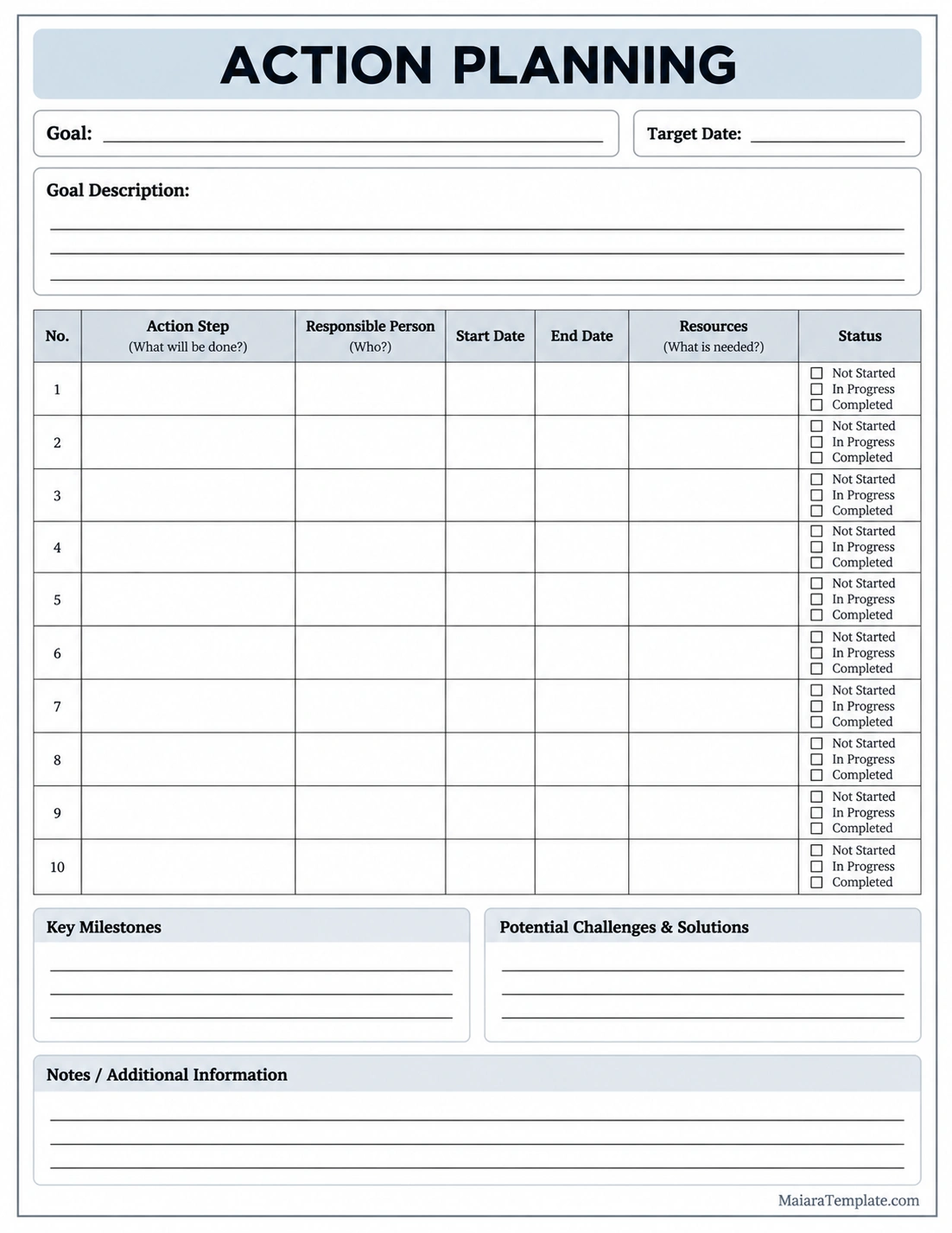
The template includes a goal section, a target date, and space to describe the desired outcome. Its main action table provides fields for individual tasks, responsible people, start and end dates, required resources, and task status.
Additional sections help you record key milestones, potential challenges, possible solutions, and supporting notes. You can print the worksheet on US Letter paper and complete it by hand, or recreate the structure in a spreadsheet or digital document.
Key Components of an Effective Action Plan
Although action plans vary according to their purpose, most effective plans include several essential components.
A Clear Goal
The goal describes what you want to achieve. It should be specific enough to guide your decisions and provide a clear definition of success.
For example, “Improve customer service” is a broad goal. “Reduce average customer response time from 24 hours to 8 hours within three months” provides a more measurable target.
Specific Action Steps
Action steps describe the work required to achieve the goal. Each task should be clear, manageable, and connected to the desired outcome.
Instead of writing “Improve the website,” break the work into smaller actions such as reviewing existing pages, identifying usability problems, updating navigation, testing mobile performance, and measuring results.
Assigned Responsibilities
Each action step should have a responsible person or team. Clear ownership reduces confusion and makes it easier to identify who can provide updates or resolve problems.
For collaborative projects, distinguish the person responsible for completing a task from anyone who provides support or approves the final result.
Deadlines and Milestones
Deadlines establish when tasks should begin and finish. Milestones mark important stages of progress, such as completing research, approving a design, or launching a new process.
Set realistic dates based on workload, dependencies, and available resources. A schedule that ignores these factors can make even a well-designed plan difficult to execute.
Required Resources
List the resources needed for each action, such as staff time, funding, software, equipment, training, or access to information. Identifying these requirements early helps prevent unnecessary interruptions.
Success Measures
Define how you will determine whether the plan is successful. Depending on the goal, measures may include completion rates, cost savings, sales growth, customer satisfaction, or the number of tasks completed on schedule.
Potential Challenges and Solutions
Consider what could prevent progress. Common challenges include limited resources, conflicting priorities, delayed approvals, and unexpected changes.
For each significant risk, identify a practical response. Preparing alternatives in advance can help the team respond quickly when circumstances change.
How to Create an Action Plan Step by Step
Creating an action plan becomes easier when you follow a consistent process. The following steps can help you turn a general objective into an organized set of tasks.
Define the Desired Outcome
Begin by explaining what you want to accomplish and why it matters. Identify the result that would demonstrate success, and make sure the goal is realistic within the available time and resources.
Break the Goal Into Tasks
List the actions required to reach the outcome. Start with the major activities, then divide complex activities into smaller tasks that can be completed and reviewed individually.
Arrange the tasks in a logical order. If one activity depends on another, make that relationship clear before setting deadlines.
Assign Owners and Deadlines
Give every important task a responsible person and a target completion date. Confirm that the assigned people understand the expected result and have enough time to complete their work.
Identify Resources and Constraints
Determine what each task requires and whether those resources are available. If the plan depends on a budget approval, specialist support, or external delivery, include that dependency in the schedule.
Set Milestones and Measures
Choose checkpoints that help you evaluate progress before the final deadline. Establish relevant performance indicators so that you can distinguish completed activities from actual results.
Monitor Progress Regularly
Review task status at a frequency that suits the project. Short projects may need frequent check-ins, while longer initiatives may use weekly or monthly reviews.
Discuss completed work, overdue tasks, new risks, and decisions needed to keep the plan moving.
Update the Plan When Necessary
An action plan should guide the work, not prevent reasonable changes. If priorities, deadlines, or available resources change, revise the relevant tasks and communicate the updates to everyone involved.
Action Planning Examples
Action planning can be adapted to personal goals, education, business operations, and team projects. The following examples show how a broad objective can become a practical plan.
Personal Development Action Plan
A person who wants to improve professional skills might set a goal to complete a relevant course within eight weeks. The action steps could include researching courses, choosing a program, scheduling study sessions, completing assignments, and taking a final assessment.
Progress can be measured through completed lessons, study hours, and the final assessment result.
Business Improvement Action Plan
A business aiming to increase customer retention might begin by reviewing customer feedback and identifying the most common reasons for cancellations. The team could then improve onboarding, update support materials, and measure retention rates each month.
Each task should have an owner, a deadline, and a measurable result so that the business can evaluate whether the changes are effective.
Project Management Action Plan
A project team preparing a product launch might organize work into research, development, testing, marketing, and release activities. Milestones can mark approval of the design, completion of testing, and readiness for launch.
The action plan should also identify dependencies. For example, marketing materials may need final product specifications before they can be approved.
School or Academic Action Plan
A student preparing for an examination might create a schedule covering topic review, practice questions, revision sessions, and mock tests. The plan can allocate study time according to topic difficulty and the examination date.
Tracking completed sessions and practice scores helps the student identify areas that need additional attention.
Action Planning vs. Strategic Planning
Strategic planning and action planning are closely related, but they serve different purposes.
- Strategic planning: Defines the broader direction, priorities, and long-term objectives of an organization or individual.
- Action planning: Converts those priorities into specific tasks, responsibilities, deadlines, resources, and measures of progress.
For example, a company’s strategic plan may identify customer retention as a major priority. Its action plan can specify the customer research, service improvements, training activities, and performance measures needed to support that priority.
Strategic planning explains where you want to go and why. Action planning explains what needs to happen next to move in that direction.
Common Action Planning Mistakes to Avoid
A plan can look organized but still fail if its tasks are unclear or its deadlines are unrealistic. Avoid these common mistakes when developing your action plan.
- Setting vague goals: Define the desired outcome and how success will be measured.
- Creating too many tasks: Focus on actions that contribute directly to the goal and divide complex work into manageable steps.
- Leaving responsibilities unclear: Assign a clear owner to every important task.
- Using unrealistic deadlines: Consider workload, dependencies, approvals, and available resources.
- Ignoring risks: Identify likely obstacles and decide how to respond.
- Failing to monitor progress: Schedule regular reviews instead of waiting until the final deadline.
- Confusing activity with results: Measure whether the work achieved the intended outcome, not only whether tasks were completed.
Tips for Successful Action Planning
A practical action plan should be clear, realistic, and easy to maintain. These tips can help improve its effectiveness.
- Keep the goal visible: Make sure every major task supports the intended outcome.
- Use measurable targets: Define specific results whenever possible.
- Prioritize high-impact tasks: Complete important activities before spending time on low-value details.
- Communicate responsibilities: Ensure everyone understands their role and deadlines.
- Build in flexibility: Allow reasonable room for delays and unexpected changes.
- Record decisions: Document important changes so the team can follow the latest plan.
- Celebrate milestones: Recognize meaningful progress to maintain motivation.
Frequently Asked Questions About Action Planning
What is the main purpose of action planning?
The main purpose of action planning is to translate a goal into specific steps that can be scheduled, assigned, and measured. It provides a practical roadmap for moving from an objective to a completed result.
What should an action plan include?
An action plan should include a clear goal, specific tasks, responsible people, deadlines, required resources, progress measures, and relevant milestones. It can also include potential challenges and contingency actions.
What is an action planning template?
An action planning template is a preformatted worksheet or document used to organize goals, tasks, responsibilities, deadlines, and progress. It helps users create consistent plans without designing the structure from scratch.
What is the difference between an action plan and a to-do list?
A to-do list records tasks that need to be completed. An action plan connects tasks to a specific goal and often includes ownership, deadlines, resources, dependencies, milestones, and measures of success.
Who can use action planning?
Students, individuals, managers, project teams, business owners, teachers, and nonprofit organizations can use action planning. It is useful whenever a desired result requires coordinated steps and measurable progress.
How often should an action plan be reviewed?
The review schedule depends on the goal and project duration. A short or fast-moving project may require frequent check-ins, while a longer initiative may use weekly or monthly reviews. The important point is to review progress often enough to address problems before they become serious.
Can an action plan change after it has been created?
Yes. An action plan should be updated when priorities, deadlines, resources, or circumstances change. Record important revisions and communicate them to the people responsible for completing the work.
How do you measure the success of an action plan?
Measure success by comparing actual results with the original goal and its success criteria. Useful measures may include completion dates, budget performance, quality improvements, customer satisfaction, or other indicators relevant to the objective.
Conclusion
Action planning helps turn broad goals into practical steps, clear responsibilities, realistic deadlines, and measurable results. It gives individuals and teams a structured way to organize work, allocate resources, manage challenges, and monitor progress.
Using an action planning template makes it easier to document each part of the process in one place. Define the desired outcome, break it into manageable tasks, assign responsibilities, and review progress regularly.
Whether you are pursuing a personal goal, managing a business initiative, or coordinating a team project, effective action planning can provide the structure needed to work more efficiently and move toward meaningful results.
Download: Action Planning Template

- Affirmative Action Plan Template - October 11, 2026
- Free Printable Affidavit Form Template - October 11, 2026
- Free Printable Address Label Template - October 11, 2026
