Bank reconciliation is an essential accounting process that compares a company’s internal cash records with its bank statement to confirm that both balances are accurate. By identifying differences such as outstanding checks, deposits in transit, bank fees, and recording errors, businesses can maintain reliable financial records and understand their true cash position.
Whether you manage a small business, work in accounting, or handle your own bookkeeping, regular bank reconciliation helps prevent errors, detect unusual transactions, and improve financial control. It also provides a clearer picture of available cash for paying expenses, planning budgets, and preparing financial reports.
In this guide, you will learn what bank reconciliation is, why it matters, which items to review, and how to complete the process step by step. You will also discover how a bank reconciliation template can make monthly bookkeeping more organized and consistent.
What Is Bank Reconciliation?
Bank reconciliation is the process of comparing the ending balance shown on a bank statement with the cash balance recorded in a company’s accounting system or cash book. The goal is to explain the differences between the two balances and determine whether adjustments are necessary.
The balances may not match immediately because the bank and the business record transactions at different times. For example, a company may record a customer payment before the deposit appears on the bank statement. Similarly, a check issued by the business may remain uncashed at the end of the reporting period.
A completed bank reconciliation identifies these timing differences, corrects errors where necessary, and helps establish the adjusted cash balance. After all valid reconciling items are considered, the adjusted bank balance and adjusted book balance should agree.
Why Is Bank Reconciliation Important?
Regular bank reconciliation supports accurate bookkeeping and helps businesses maintain better control over their cash. It is useful for organizations of all sizes, from freelancers and small businesses to larger companies with multiple bank accounts.
1. Improves Financial Accuracy
Comparing bank transactions with accounting records helps identify missing entries, duplicate transactions, incorrect amounts, and posting mistakes. Correcting these issues improves the reliability of the cash balance reported in financial statements.
2. Helps Detect Unusual Transactions
Reconciliation gives businesses an opportunity to investigate unfamiliar withdrawals, unexpected fees, duplicate payments, or transactions that may indicate unauthorized activity. It does not guarantee that fraud will be detected, but it provides an important internal control.
3. Provides Better Cash Flow Visibility
A bank statement balance may differ from the amount recorded in the accounting system. Reconciling these differences helps management understand which funds have cleared, which deposits are still processing, and which payments remain outstanding.
4. Supports Reporting and Tax Preparation
Accurate cash records make it easier to prepare financial statements, review expenses, and organize documentation for tax reporting. Reconciliation is not a substitute for tax advice or a complete audit, but it helps establish more dependable accounting records.
5. Strengthens Internal Controls
A consistent reconciliation process creates a regular review of cash activity. Businesses can improve accountability by assigning responsibility, retaining supporting documents, and having someone independent review important reconciliations when practical.
Common Items That Cause Bank Reconciliation Differences
Before adjusting any balances, identify why the bank statement and accounting records differ. Many discrepancies are normal timing differences, while others require corrections or investigation.
Deposits in Transit
Deposits in transit are payments already recorded in the company’s books but not yet shown on the bank statement. This can happen when a deposit is made near the end of a reporting period or takes time to process.
Outstanding Checks and Payments
An outstanding check is a payment recorded by the business that has not yet cleared the bank. Similar timing differences can occur with electronic payments that have been initiated but have not yet appeared on the statement.
Bank Fees and Service Charges
Monthly account fees, transaction charges, and other bank expenses may appear on the statement before the business records them. These items generally require an entry in the accounting records if they have not already been recorded.
Interest Earned
Interest credited to a bank account may not be included in the company’s books until the statement is reviewed. Record the interest income in the accounting system when appropriate.
Returned Payments and Non-Sufficient Funds
A customer payment may initially appear to have been received but later be returned by the bank. The accounting records may need to be updated to reflect the returned payment and any associated charges.
Recording Errors and Unauthorized Transactions
Incorrect amounts, duplicate entries, transactions posted to the wrong account, or unfamiliar withdrawals can cause differences. Verify each item against supporting documents and investigate suspicious activity promptly with the bank when necessary.
How to Complete Bank Reconciliation Step by Step
Following a consistent process makes bank reconciliation easier to complete and review. The steps below can be adapted to a manual cash book, spreadsheet, or accounting software.
Step 1: Gather the Required Records
Obtain the bank statement for the period, the general ledger or cash book, and supporting records such as deposit receipts, check details, payment confirmations, and bank notices. Make sure the statement and accounting records cover the same account and reporting period.
Step 2: Compare Transactions
Match each transaction on the bank statement with the corresponding entry in the accounting records. Compare transaction dates, descriptions, amounts, and reference numbers. Mark matched items so they are not reviewed repeatedly.
Step 3: Identify Deposits in Transit
Review deposits recorded in the books that do not appear on the bank statement. Confirm that each deposit is supported by a receipt or other evidence. Add valid deposits in transit when calculating the adjusted bank balance.
Step 4: Identify Outstanding Checks and Payments
List checks and other payments that have been recorded in the books but have not cleared the bank. Verify that they are legitimate and have not already been included in another transaction. Subtract valid outstanding payments when calculating the adjusted bank balance.
Step 5: Record Bank-Only Transactions
Look for bank fees, interest income, returned payments, and other transactions that appear on the statement but are missing from the accounting records. Enter the appropriate adjustments in the books, following the organization’s accounting procedures.
Step 6: Investigate Errors and Unusual Items
Check unmatched transactions for incorrect amounts, duplicate entries, omissions, or potentially unauthorized activity. Correct errors only after verifying the supporting evidence. If a bank error is suspected, contact the bank and track the issue until it is resolved.
Step 7: Calculate the Adjusted Balances
Calculate the adjusted bank balance and adjusted book balance using the identified reconciling items. The two adjusted balances should agree when all relevant items have been correctly identified and processed.
Step 8: Post Adjustments and Review the Reconciliation
Post the required journal entries to the accounting records. Review the final calculations, retain supporting documents, and document any unresolved differences. Where possible, ask another authorized person to review the reconciliation before it is finalized.
Bank Reconciliation Template
A bank reconciliation template provides a structured way to compare statement balances with accounting records. It helps organize deposits in transit, outstanding checks, bank-only transactions, adjustments, and unresolved differences in one place.
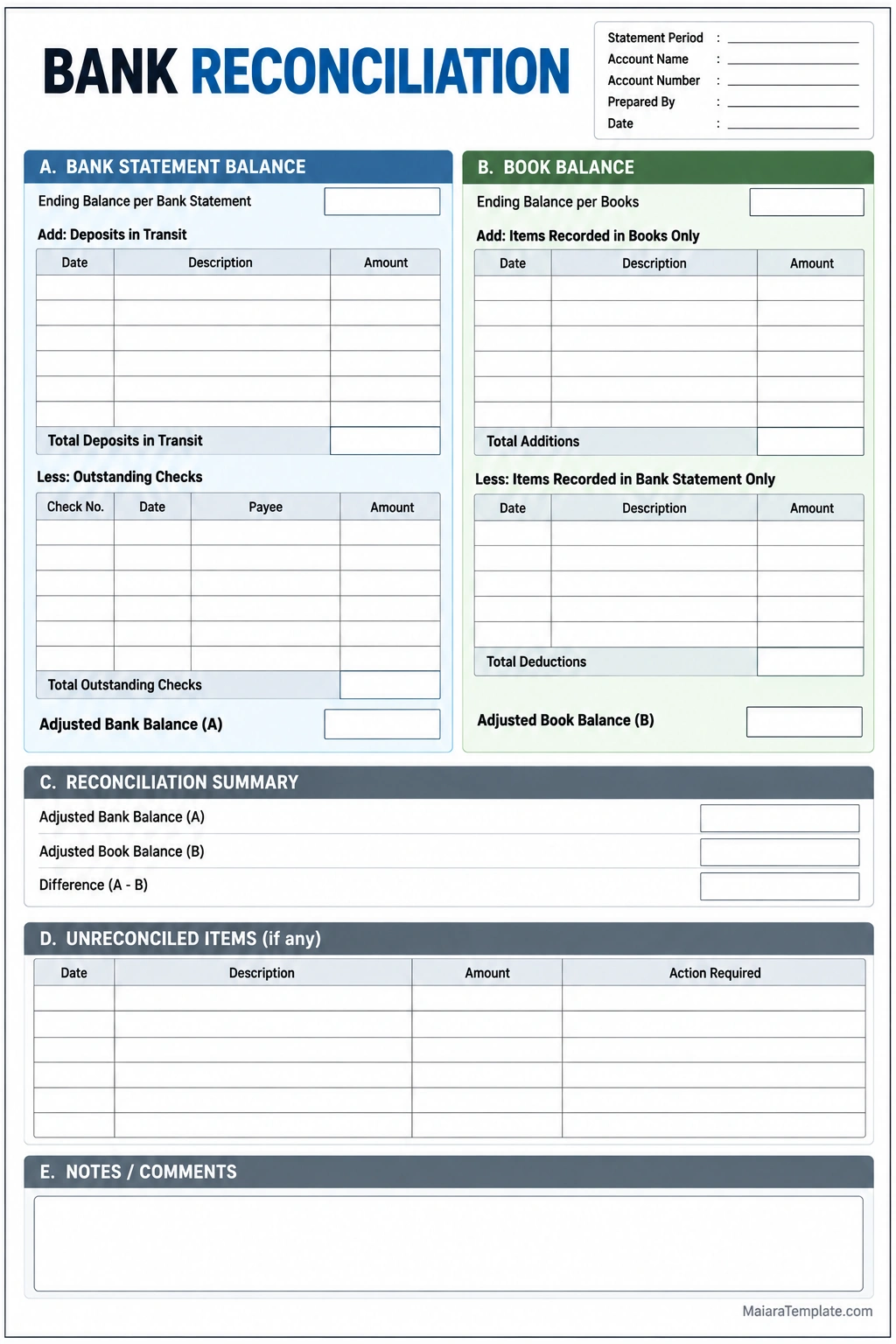
When using a worksheet, complete the bank and book sections separately before calculating the final adjusted balances. Include the statement period, account name, preparation date, and any notes needed to explain unusual items.
Example of a Bank Reconciliation
The following example illustrates how timing differences and bank-only transactions affect a reconciliation. The amounts are fictional and are provided for demonstration purposes only.
- Ending bank statement balance: $5,000
- Add deposits in transit: $800
- Less outstanding checks: $600
- Adjusted bank balance: $5,200
Now consider the company’s accounting records:
- Ending book balance: $5,250
- Add interest earned not yet recorded: $20
- Less bank service fee not yet recorded: $70
- Adjusted book balance: $5,200
In this example, both adjusted balances equal $5,200. The difference between the original balances has been explained by deposits in transit, outstanding checks, interest income, and a bank service fee.
If the adjusted balances do not agree, do not force the figures to match. Review the calculations, verify the transaction records, and investigate any remaining difference before finalizing the reconciliation.
Best Practices for Accurate Bank Reconciliation
- Reconcile regularly. Monthly reconciliation is a common practice, while high-volume accounts may benefit from more frequent reviews.
- Use consistent procedures. Follow the same review steps each period to reduce omissions and improve accountability.
- Keep supporting documentation. Retain statements, receipts, payment confirmations, and explanations for adjustments.
- Investigate old outstanding items. Long-standing checks or deposits may require follow-up rather than being carried forward indefinitely.
- Separate preparation and review when possible. Independent review can strengthen internal controls, especially for businesses with significant cash activity.
- Protect account access. Use appropriate permissions and secure banking credentials to reduce the risk of unauthorized activity.
- Use accounting software carefully. Automated matching can save time, but unmatched transactions and unusual entries still require human review.
- Document corrections. Record the reason for each adjustment and keep evidence that supports the change.
Common Bank Reconciliation Mistakes to Avoid
Even routine reconciliations can contain errors if the process is rushed or supporting records are incomplete. Watch for these common problems:
- Comparing statements and books from different periods
- Missing deposits in transit or outstanding payments
- Recording bank fees or interest more than once
- Overlooking duplicate transactions or incorrect amounts
- Failing to follow up on old unreconciled items
- Making adjustments without supporting evidence
- Ignoring suspicious transactions or unexplained differences
- Finalizing the reconciliation before the adjusted balances agree
A difference that remains unexplained should be treated as an issue to investigate, not simply entered as a balancing figure. A clear audit trail makes it easier to understand what happened and demonstrate how the final balance was determined.
Frequently Asked Questions
What is the main purpose of bank reconciliation?
The main purpose of bank reconciliation is to verify that the cash balance in the accounting records agrees with the adjusted bank statement balance. It helps identify timing differences, missing transactions, errors, and unusual activity.
How often should bank reconciliation be performed?
Many businesses reconcile each bank account monthly after receiving the statement. Businesses with frequent transactions or greater cash risk may reconcile weekly or daily. The appropriate frequency depends on transaction volume, operational needs, and internal control requirements.
What is the difference between the bank balance and the book balance?
The bank balance is the amount reported by the financial institution, while the book balance is the amount recorded in the organization’s accounting system. The two can differ because of timing, bank-only transactions, or recording errors.
What are deposits in transit?
Deposits in transit are amounts already recorded in the company’s books but not yet included in the bank statement. They are generally added to the bank statement balance when calculating the adjusted bank balance.
What are outstanding checks?
Outstanding checks are payments recorded by the business that have not yet cleared the bank. They are generally deducted from the statement balance during reconciliation, provided they remain valid and have not already cleared.
What should I do if my bank reconciliation does not balance?
Recheck the statement period, opening balances, transaction matches, arithmetic, and reconciling items. Look for missing or duplicate entries, incorrect amounts, and bank errors. Document unresolved differences and continue investigating rather than inserting an unsupported adjustment.
Can bank reconciliation be done in Excel?
Yes. A spreadsheet can organize statement balances, book balances, deposits in transit, outstanding checks, adjustments, and the final difference. Accounting software can automate some matching tasks, but the results should still be reviewed.
Does bank reconciliation help detect fraud?
Bank reconciliation can help identify unfamiliar transactions, duplicate payments, and other warning signs. However, it cannot guarantee fraud detection. Businesses should combine reconciliation with appropriate access controls, transaction approvals, and independent reviews where practical.
Conclusion
Bank reconciliation is a fundamental accounting control that helps businesses verify their cash records, investigate discrepancies, and maintain reliable financial information. By matching bank statement transactions with internal records, accounting teams can identify timing differences, record missing transactions, and detect issues that require further attention.
Use a consistent bank reconciliation process or worksheet to document adjustments, investigate unexplained differences, and review the final balances. Performing this task regularly supports better cash management, more dependable financial reporting, and stronger internal controls.
Download: Bank Reconciliation Template

- Free Printable Baseball Scorecard Template - October 25, 2026
- Free Printable Baseball Schedule Template - October 25, 2026
- Baseball Lineup Card Template - October 25, 2026
